170 (327) BRUKER BIOSPIN User Manual Version 002
SUPER
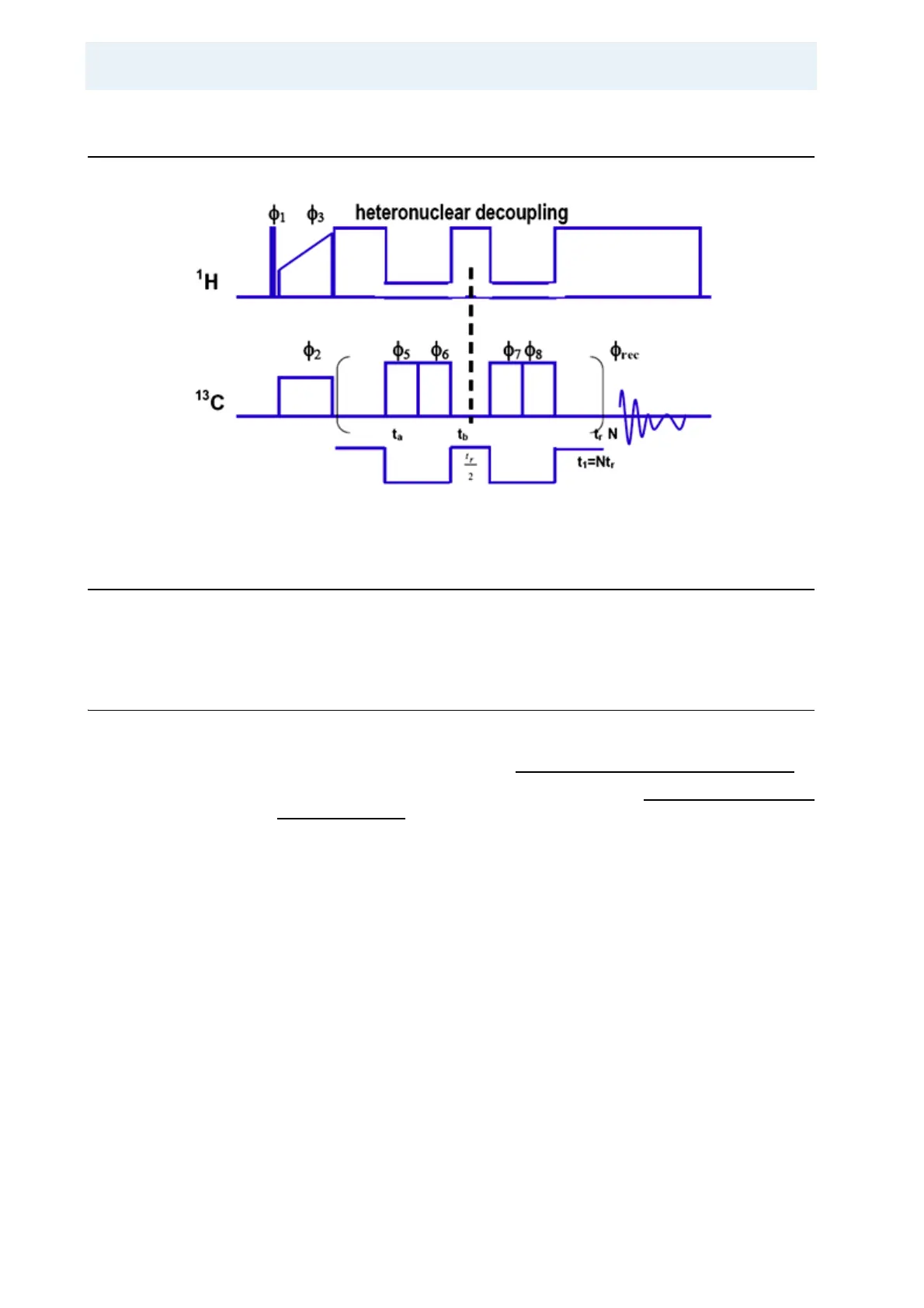
Pulse Program 13.2
Figure 13.1. Pulse Sequence for 2D CPMAS exchange experiment
2D Experiment Setup 13.3
Sample: Tyrosine HCl natural abundance.
Setup time: Less than 1 hour.
Experiment setup 13.3.1
1. In order to setup the experiment, determine
1
H-
13
C and parameters with vari-
able amplitude on
1
H according to "Basic Setup Procedures" on page 55.
2. Verify the pulse parameters on the
13
C channel (see "Pulse Calibration with
CP" on page 105) and calculate the power level required for the recoupling
pulses, i.e. f
rf
= 12.2 x f
rot
.
3. Verify pulse width.
4. Calculate power level required for heteronuclear decoupling during the recou-
pling pulses, pl23, i.e. 20 – 30 kHz or > 25 x f
rot
. Low power decoupling during
the recoupling pulses is permitted because the 360 degree pulses act like het
-
eronuclear decoupling pulses. pl22 during delays should be high.
5. The experiment requires a minimum of 64 transients to complete the phase cy-
cle. Between 32 and 64 experiments are needed for a 2D data set. Depending
on the choice for the gamma integral, more transients per slice may be re
-
quired. The recommended value is 4, which increases the number of required
transients per experiment to 256.
6. Run 1D experiment and make sure everything is set properly.
7. Create a new experiment with either iexpno or edc.
8. Change to 2D data set:



 To Next Page