136 (327) BRUKER BIOSPIN User Manual Version 002
Modifications of FSLG HETCOR
1. Load the pulse program lgcp into a standard CP/MAS data set with all parame-
ters set and optimized. Set p14 to about 54° flip angle. Use tyrosine *HCl or
the sample of interest.
2. From p3, calculate the power level pl2 for 50 kHz RF field, using calcpowlev.
3. Enter cnst17= 50000, type ased. Read the value of cnst16 (=effective field
under cnst18, cnst19 offset (about 61000 Hz). Add or subtract the spin rate
used, for instance spinning at 13 yields 74000 or 48000 Hz. If a 30% ramp is
used, and sp0 is set to 74000 (with a safety margin of 1000), the HH condition
will cover 75000 down to 45000 Hz RF field. This includes both HH sidebands
n=±1.
4. Optimize the HH-condition varying sp0, and p14, phcor1 for maximum signal.
5. Run a variation of p15 between 20 and 5000 ms on your sample (or tyrosine
*HCl). One should see intensity variations (“dipolar oscillations”) which are nor
-
mally smeared out by extensive homonuclear dipolar couplings between pro-
tons.
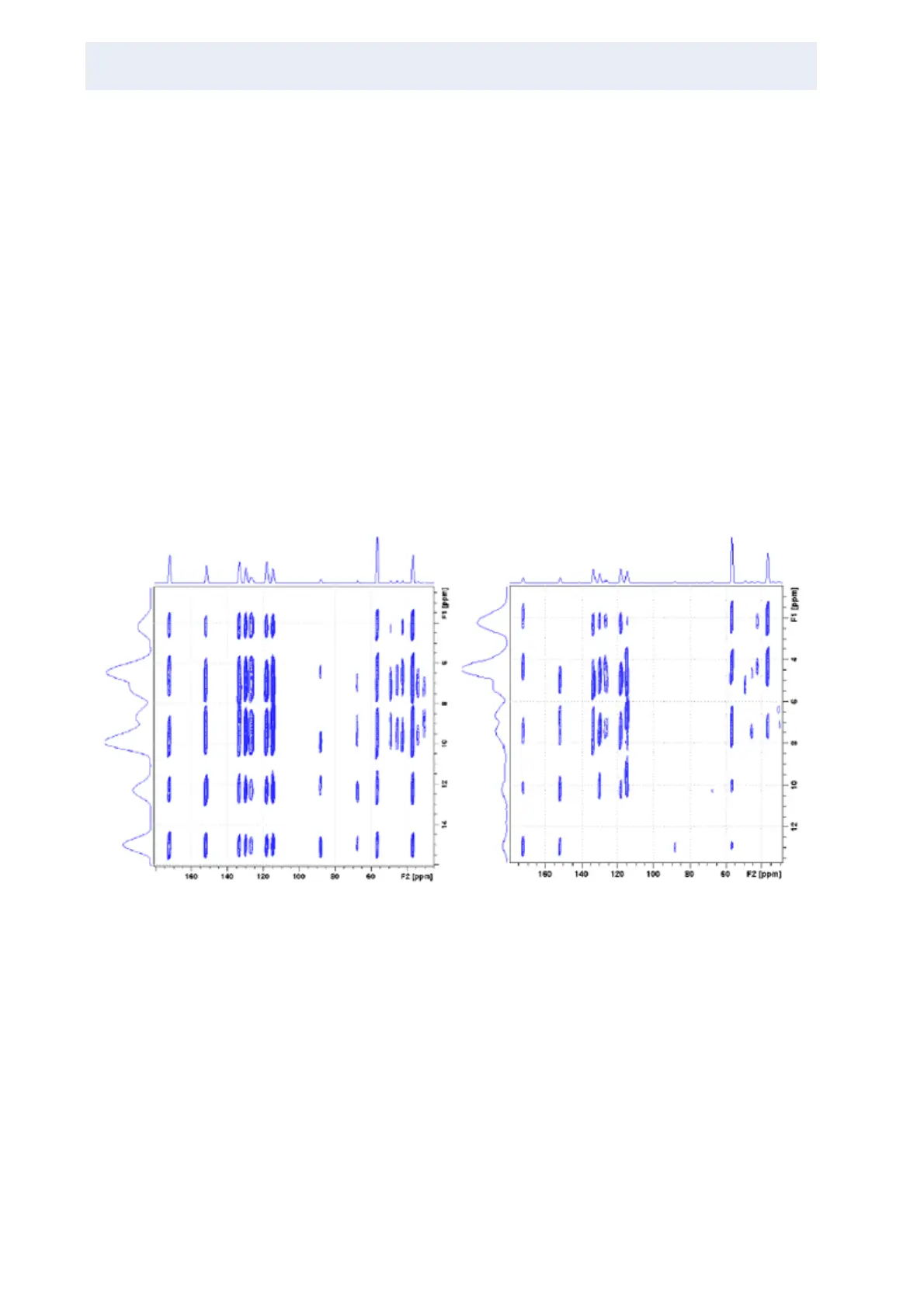
6. Set up a 2D data set with the pulse program lgcphetfq. The figures below com-
pare spectra taken with and without LG-offset during cp.
Figure 9.3. HETCOR on tyrosine *HCl without (left) and with LG contact (1msec
contact)



 To Next Page