262 (327) BRUKER BIOSPIN User Manual Version 002
Double-CP
9. Never use a pulsed proton decoupling schemes during p16. Frequency shifted
Lee-Goldburg decoupling is no alternative, since the signal will broaden and
decay with shorter T
2
. Use cw decoupling during p16, and carefully optimize
the decoupling power (pl13) for maximum signal. A slight offset may be set us
-
ing cnst24.
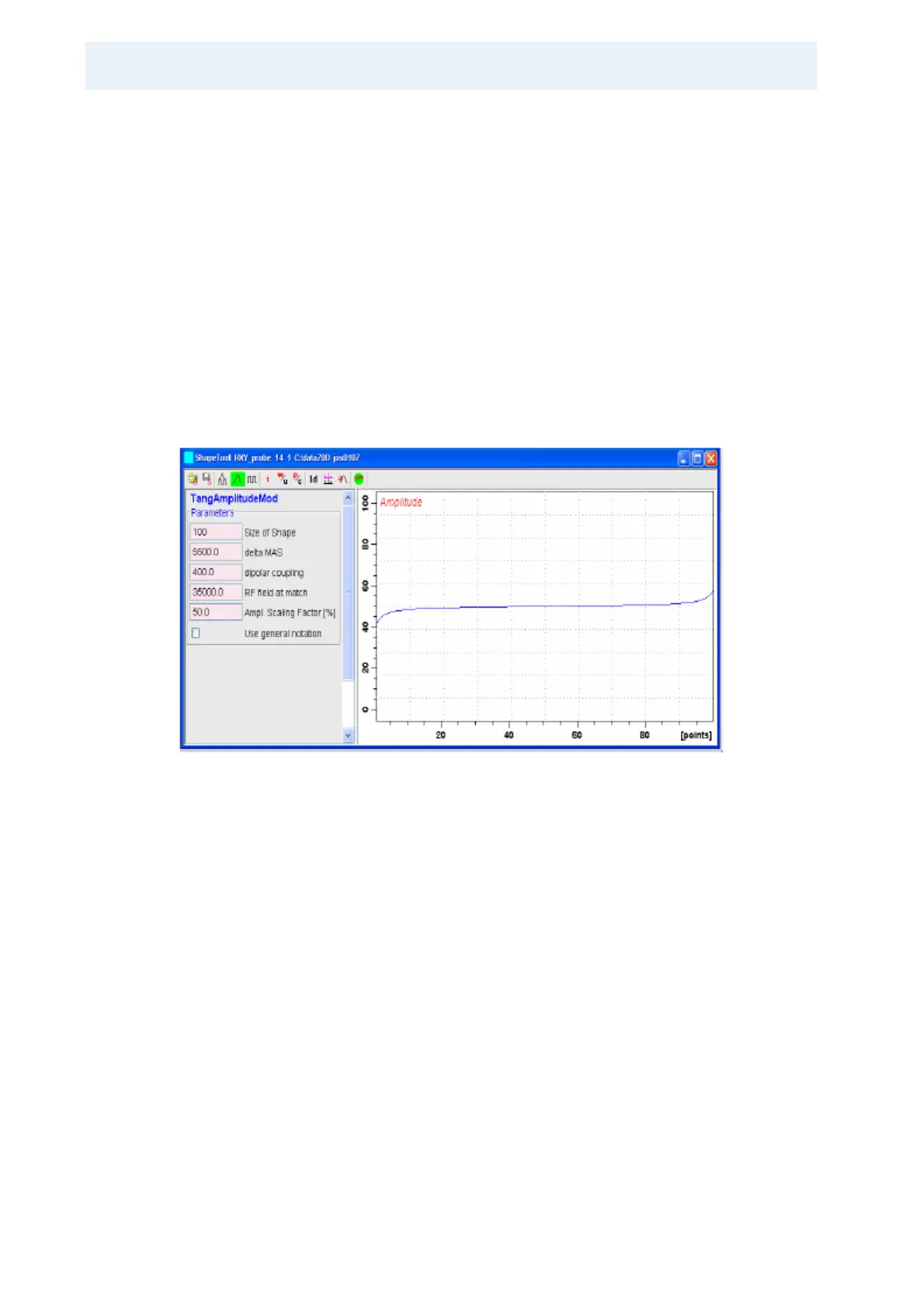
10. Instead of a 45-55% ramp, a tangential amplitude modulation shape can be
used. Since this shape provides 100% transfer efficiency on a spin pair system
(compared to 50% of a standard rectangle or ramp shape), the DCP efficiency
can be increased. With such a shape, one can get 50-70% DCP efficiency. To
generate such a shape in stdisp, select TanAmpMod as a shape model, select
solids notation, select 1000 points, set the spin rate to half the actual spin rate
(5500), set the RF field to the actual RF field used on this channel, select 400
for the dipolar coupling, and 50% for the scaling factor. Save the shape as
tcn5500 (if not already available),
and select this name for spnam1. The effi-
ciency should be noticeably better. Reoptimise the first HH contact, decoupling
and p16. More than 50% should definitely be obtained
.
Figure 20.5. Shape Tool display with a tangential shape for adiabatic cross polar-
ization.
The amplitude factor is 50%, corresponding to 50% RF field or a power level
change of +6 dB (4 fold power in TopSpin 3.0 and later), since the amplitude cor
-
responds directly to pulse voltage.
11. Optimize the DCP condition on the rectangular pulse, using 0.1 dB steps over
a range of +/-1 dB around the optimum found with the ramp.



 To Next Page