892-0000010B OM
109
3.7 Brakes
3.7.1 Service brakes and service brake control
The tractors are equipped with foot-controlled service brakes. The service brakes are
installed on the shafts of the final drive gears. Type of service brakes - dry.
The left and right service brakes are controlled either with interlocked pedals to sim-
ultaneously brake both wheels, or separately to brake the left or right wheel. Separate brak-
ing is used when performing a number of works, when increased maneuverability of the
tractor or tractor unit with minimum turning radii is required due to braking of the inner wheel.
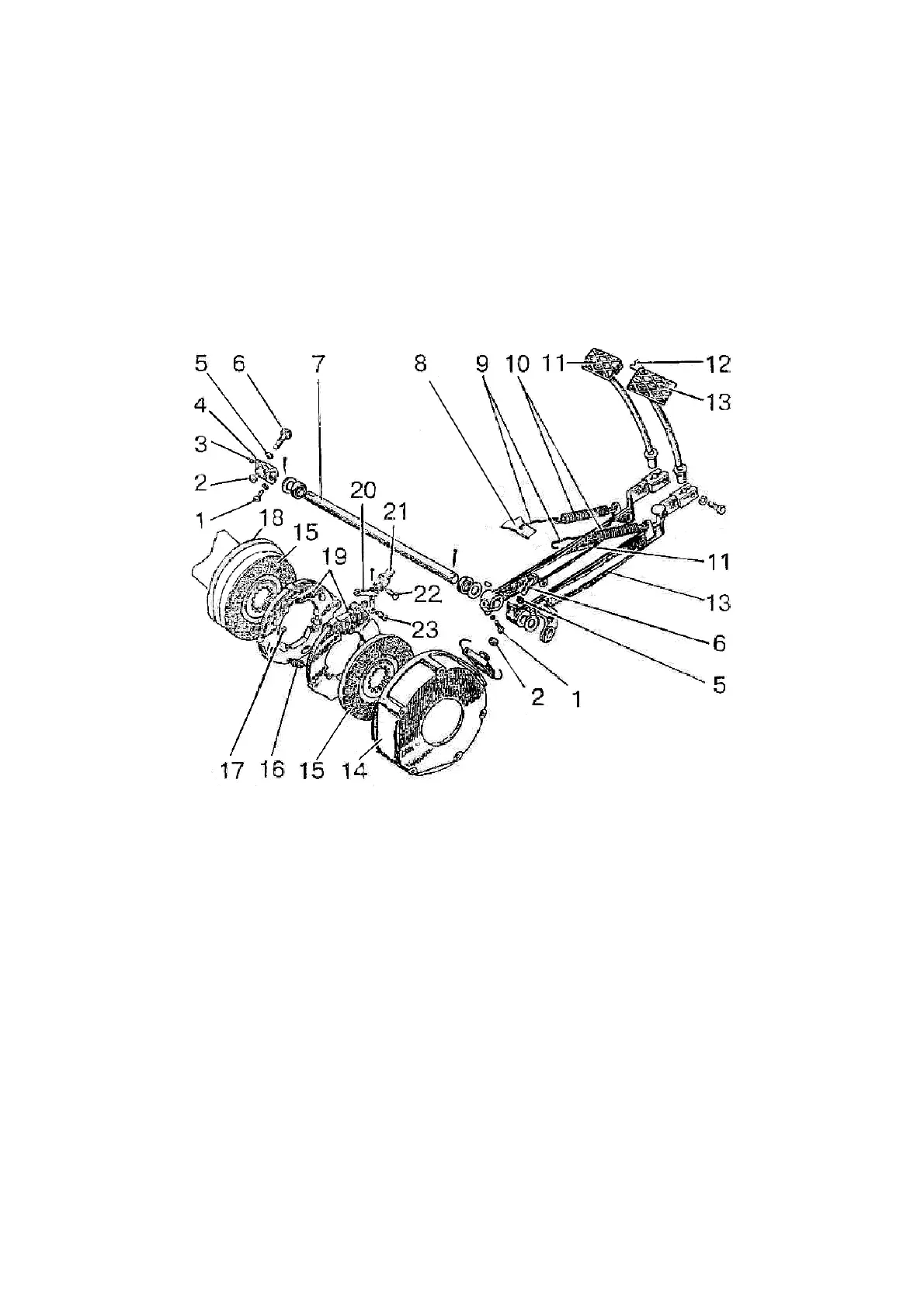
The composition of the service brake and service brake control is shown in Figure
3.7.1.
1 - bolt; 2 - locknut; 3 - key; 4 – left brake lever; 5 - spherical washer; 6 - bolt-rod; 7 -
shaft; 8 - bracket; 9 - extension; 10 - return spring; 11 – left pedal with lever; 12 - bar; 13 –
right pedal with lever; 14 - casing; 15 - brake disks; 16 - spring; 17 - ball; 18 - cage; 19 -
pressure disks; 20 - rod; 21 - yoke; 22 - pin; 23 - screw.
Figure 3.7.1 – Composition of service brakes and control of service brakes
The principle of operation of the service brakes is as follows:
As you push the brake pedals, force is transmitted from yoke 5 (Figure 3.7.2) through
pins 4 of rod 6 to pressure disks 8 and 9, turning them towards each other. While rolling with
the inclined surfaces of the profile grooves A over balls 11, pressure disks 8,9 move apart,
taking up the clearances between the friction surfaces of the disks and body parts, braking
disks 1 and the related shafts 10 and gears of the final drive. At the same time, pressure disks
8, 9 rotate by friction in the direction of rotation of brake disks 1, the rotation of pressure disk 8
is limited by stop 2. In this case, the second pressure disk 9 has the ability to rotate additionally
at a certain angle with respect to pressure disk 8 and, while rolling with the inclined surfaces of
profile grooves A over balls 11, creates additional pressure on the friction surface, enhancing
the braking effect of pressure disks 8, 9 and the tractor as a whole.



 To Next Page