6 ECG, Arrhythmia, ST and QT Monitoring
151
Note: **HR High/Low are available only if HR alarms are configured to "yellow", and *HR High/
Low are available only if HR alarms are configured to "short yellow".
Using ECG Alarms
ECG alarms can be switched on and off and the high and low alarm limits changed just like other
measurement alarms, as described in the “Alarms” chapter. Special alarm features which apply only to
ECG are described here.
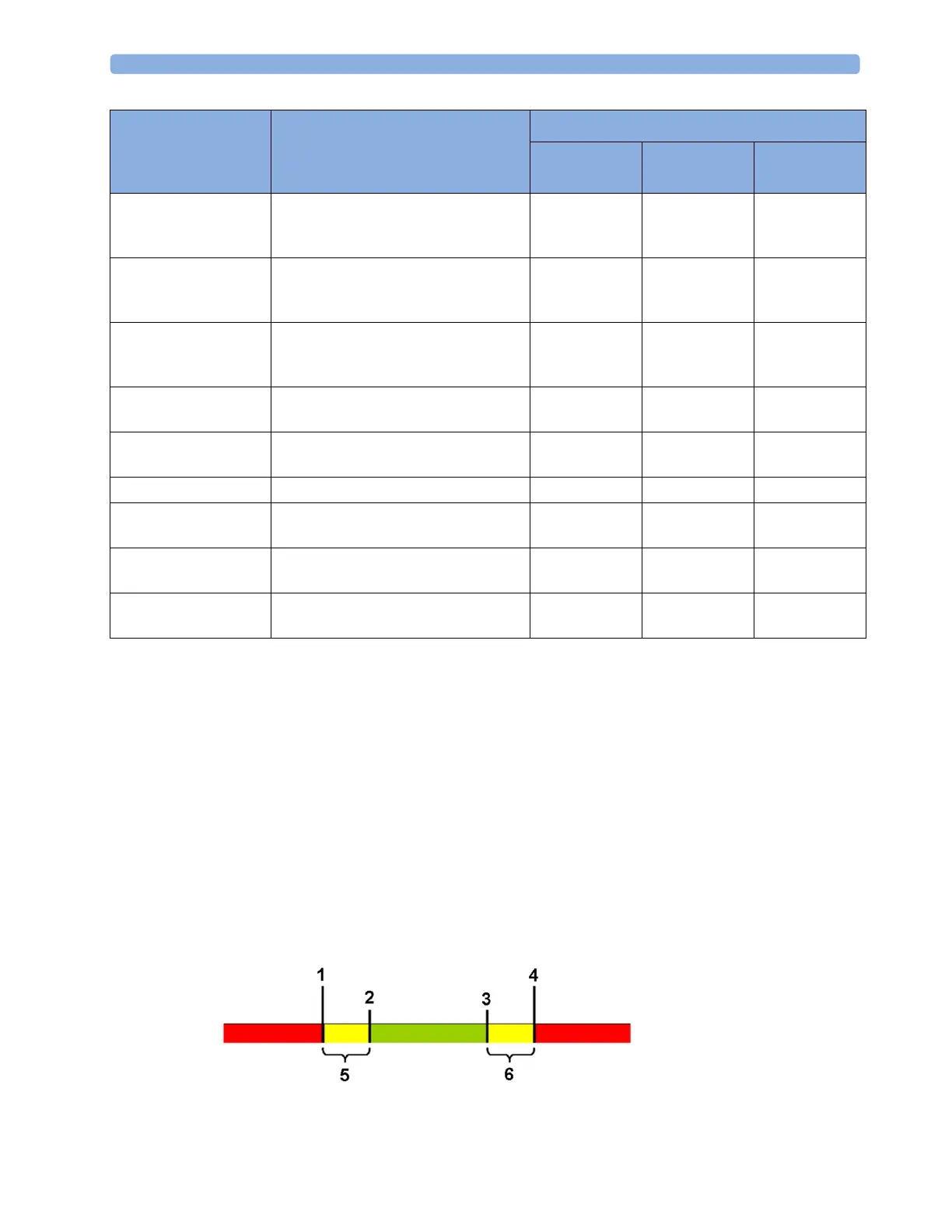
Extreme Alarm Limits for Heart Rate
The extreme rate alarms, Extreme Tachy and Extreme Brady, generated by the active alarm source,
either HR or Pulse, are set in Configuration Mode by adding a set value (the Δ value) to the high and
low alarm limits.
** Pacer Not Capt No beat detected for > 1.75*(the
averaged R-R interval) with detected
pace pulse(s). (For paced patients only)
xx
**Pacer Not Pacing No beat and pace pulse detected for >
1.75*(the averaged R-R interval). (For
paced patients only)
xx
** SVT A run of supraventricular beats > the
SVT run limit and heart rate > the SVT
HR limit
x
* HR High Heart rate > the high HR alarm limit x
(see note)
x
(see note)
* HR Low Heart rate < the low HR alarm limit x
(see note)
x
(see note)
* AFIB Atrial fibrillation waveform detected x
* End AFIB Atrial fibrillation no longer detected for
the configured Afib end delay time
x
** Irregular HR Consistently irregular rhythm (irregular
R-R intervals)
x
* End Irregular HR Irregular HR no longer detected for the
configured irregular HR end delay time
x
Alarm Description Arrhythmia Configuration
Arrhythmia
Off
Basic
Arrhythmia
Enhanced
Arrhythmia
1 Extreme Brady Limit
2 Low Limit
3 High Limit
4 Extreme Tachy Limit
5 Δ Extreme Brady
6 Δ Extreme Tachy



 To Next Page