98 VS1 Editor Configuration Application
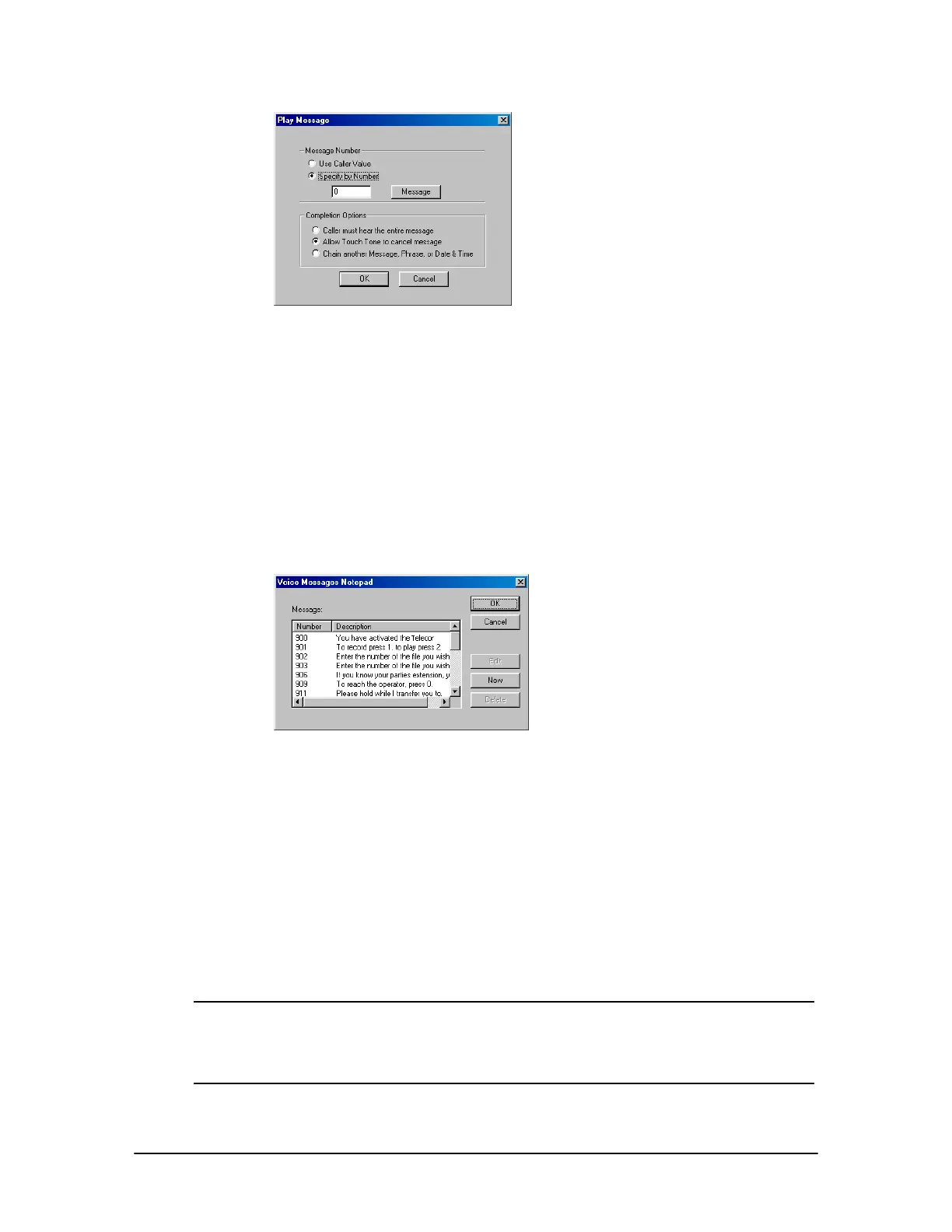
Play Message dialog
box
2. Click in the Specify by Number text box that appears and type in a voice file number. Note
that voice file numbers 11-13 and 900-999 are already reserved with voice files. See “Pre-
recorded Message List” in Reference section for a list of reserved messages.
3. Click the Message button.
4. The Voice Message Notepad window is displayed. Click New to describe the voice file you
typed in the Specify by number text box. A message needs to be assigned a number and its text
content. The actual message is stored by the Voice Message Recorder Auto Attendant. Message
files for all Auto Attendants appear in this window. Use care when deleting or editing one of
these messages because all Auto Attendants using that message are affected. See “Recording a
Voice File” in Reference section to record a voice file.
Voice Messages
notepad dialog box
5. Select a Completion Option.
• Caller Must Hear the Entire Message: This option is used when a Voice Message is being
played and the caller is not allowed to interrupt the message with DTMF tones. If the caller
does enter a tone, it is ignored by the system and the Voice Message continues playing until it
is complete.
• Allow Touch Tone to Cancel Message: Allow Touch Tone to Cancel Message is the most
common option selected. With this option, the caller may interrupt the playing of the Voice
Message with a DTMF tone. The Auto Attendant immediately takes action on the tone(s)
entered by the caller.
Note If you are playing a series of consecutive voice files (Messages, Phrases, Date & Time)
within one Caller Greeting, do not choose this option for any of the voice files except the
last one in the series. If you set up all the files in the series to use this option, the Auto
Attendant recognizes the DTMF tone(s) only for the purpose of skipping to the next voice
file in the series, not for the purpose of taking action on the caller’s response.


 To Next Page