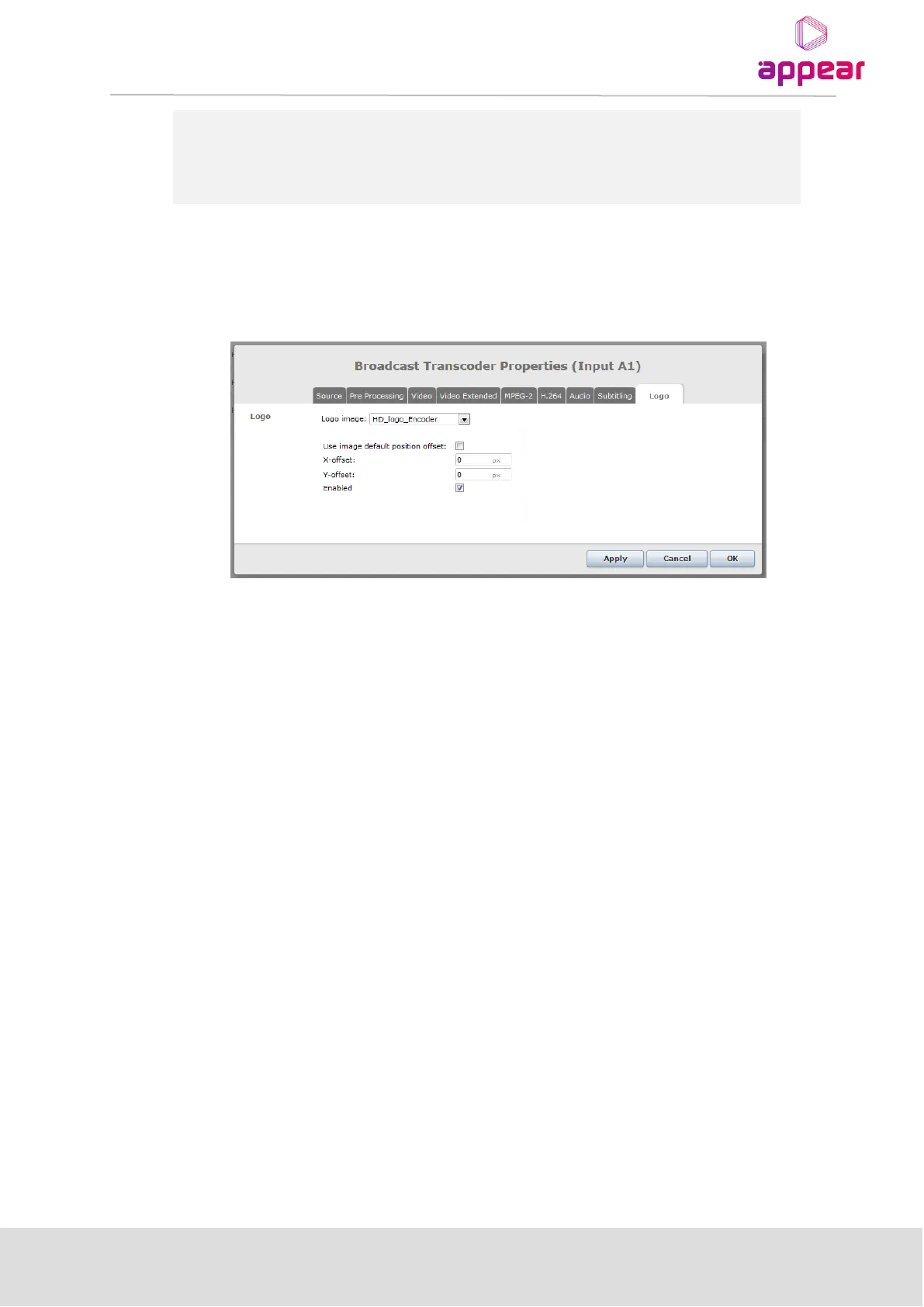
9.3.9 LOGO INSERTION
Once there is a valid logo on the MMI (section 0), then it is possible to assign this to a transcoder channel. This is
configured on the Logo tab:
Once the correct logo resolution is chosen for the service and the offset set, the logo can then be enabled.
9.4 STATISTICAL MULTIPLEXING
The principle of statistical multiplexing is that a group of video encoders/transcoders (referred to as a StatMux
group) shares a fixed quantity of TS bandwidth. The bandwidth is distributed by a centralized StatMux controller,
and the program with the most complex video may be allowed to use more bandwidth than programs with less
complex video or with a lower priority.
The statistical probability that all programs in a multiplex shall demand a high bit rate at the exact same time
decreases when the size of the multiplex group increases.
The motivation for a Statmux system is to either:
• Avoid spending bandwidth on simple video sequences in order to free up capacity for new programs in
the multiplex.
• Distribute available multiplex bandwidth between programs in order to increase overall video quality
(VQ), by minimizing overall quantization (QP)
9.4.1 MODULE AND STATMUX ENGINE SUPPORT
In the Appear system there are two Statistical Mulitplex engines (Normal and Universal) and depending on the
modules installed in the unit, only one of these is activated at a time.
The following encoder/transcoder modules types are supported in the Normal Statmux Engine :
• EC-100, EC-200 and TC-100
The following encoder/transcoder modules types are supported in the Universal Statmux Engine :



 To Next Page