APPEAR AS Confidential 311/352
The IP output module sends services out as IP multicasts, relying on OSPF and PIM messages to configure the
network. The routers use this information to route the multicasts. The network automatically detects the
presence of more than one route and redundant packets are thrown away by the routers before they reach the
STBs.
A typical scenario is to broadcast a Digital TV service from two locations using the same multicast destination
address. The network is designed to route only one copy of the multicast stream to the receiver. In case of a
source failure, with IP output redundancy implemented, the network should automatically switch to the spare
source.
By assigning the same (Source, Group) address from the virtual segment for the “main” and “backup” service the
routers regard the multicast from the “main” and the “backup” unit as one multicast origin from the virtual
source network and will automatically chose to forward packets only from the one with the lowest cost. This is
important and must be ensured when the unit is configured.
The output redundancy configuration is split on two locations. The global settings that applies to an output card,
and the per stream settings applied on a particular output.
12.3.3 GLOBAL SETTINGS
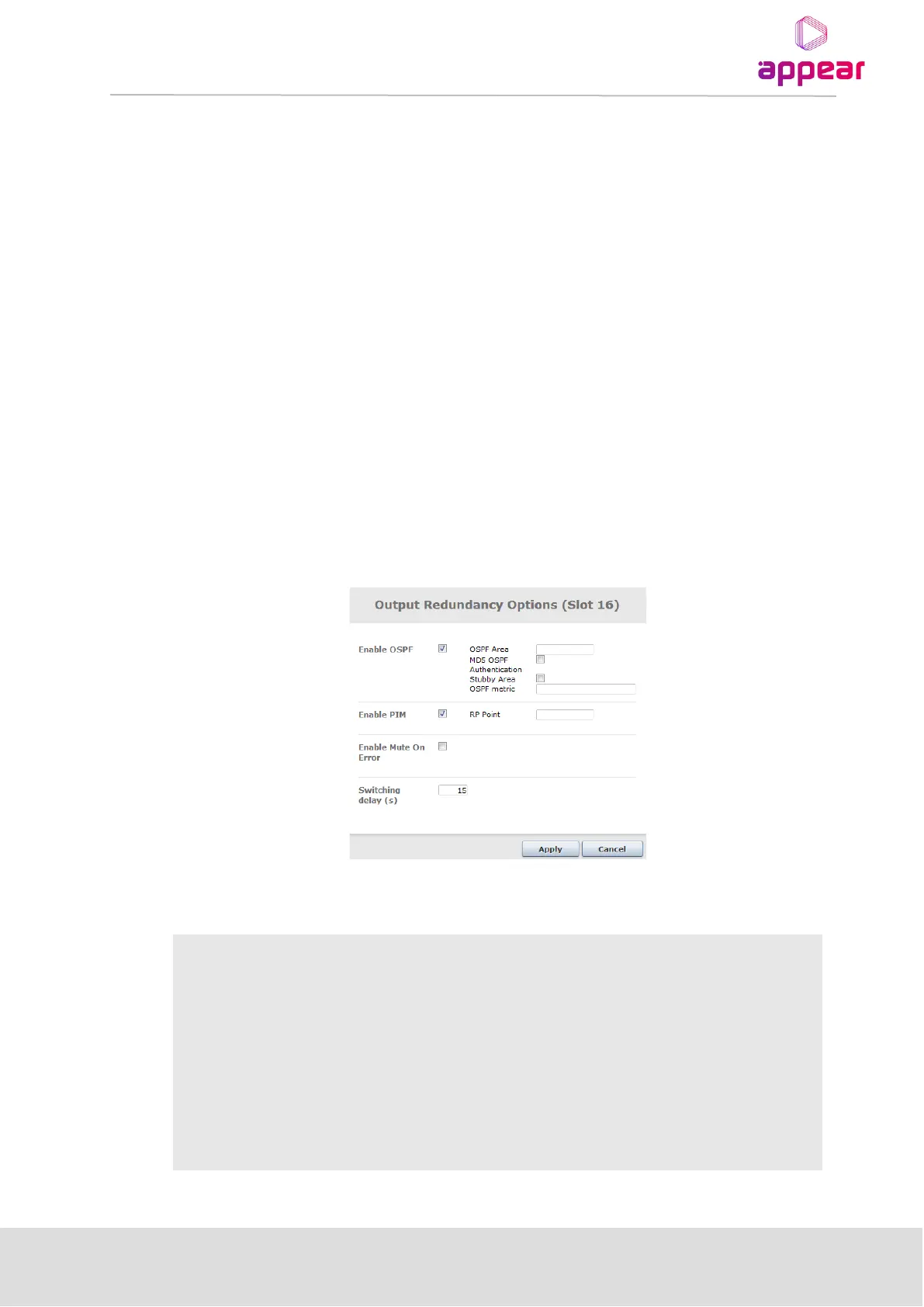
The global settings are available on the Redundancy->Output page in the GUI and are configured per output
module.
Enables OSPF routing – checking this box allows the following
parameters to be configured: OSPF Area, MD5 OSPF Authentication,
and Stubby Area.
OSPF is used to update the routing tables in the routers. The
redundancy scheme currently does not support any other routing
protocols.
Provided PIM is not controlled by the Appear equipment, it is possible to
support multiple OSPF neighbours.
This feature requires the output redundancy license.



 To Next Page