Maintenance and Service
Diesel engine
322 / 476
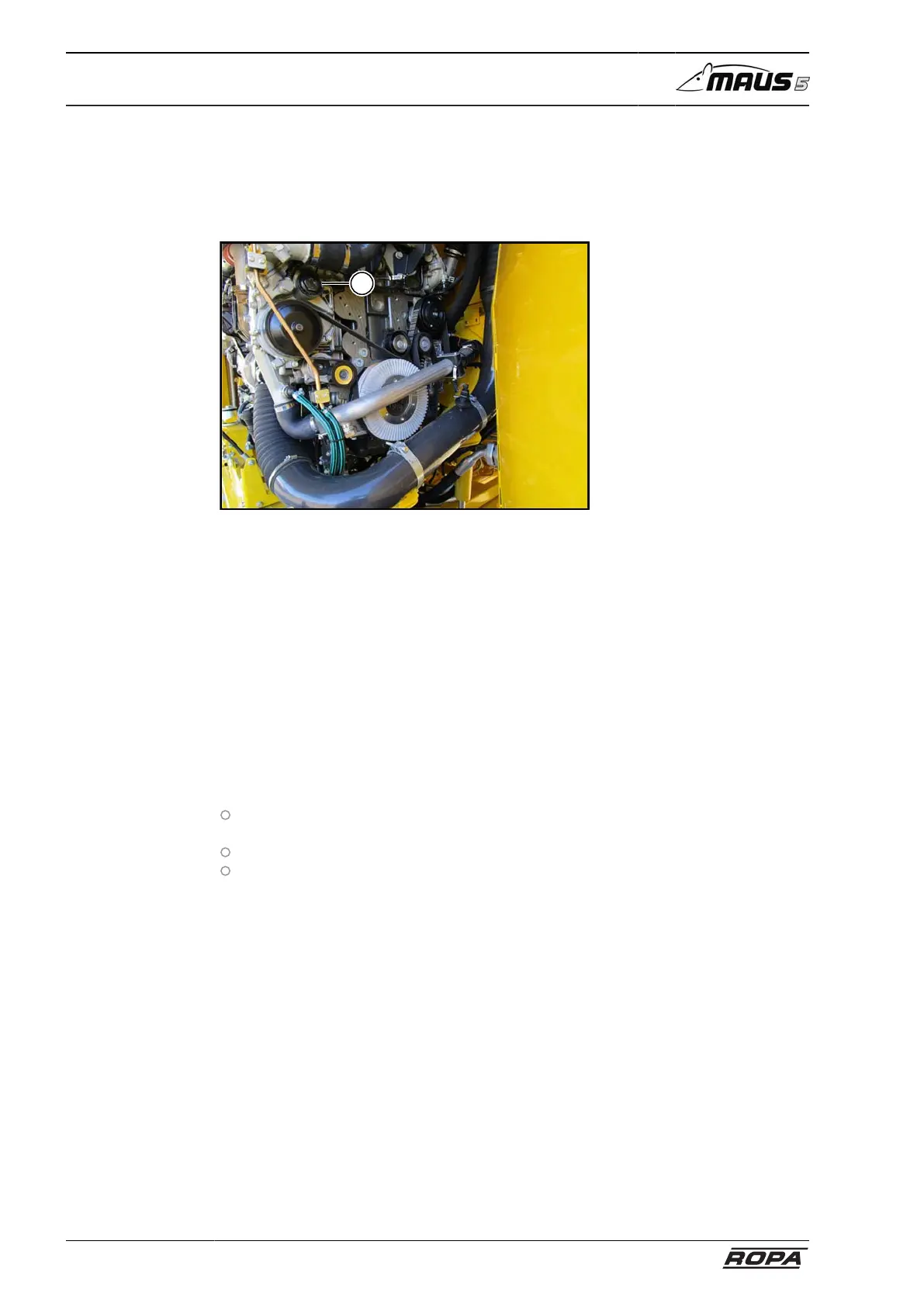
7.1.4.3.1 Renew silicate cartridge
The cooling system is fitted with a silicate container. The cartridge must be replaced
every three years. Always replace the silicate cartridge (ROPA item no. 303276) when
the coolant is changed.
1
(1) Silicate cartridge
– Shut down the diesel engine.
– Put an oil-resistant collecting vessel of sufficient size underneath.
– Replace the silicate cartridge and tighten the new silicate cartridge with a torque of
50 Nm.
– Check the coolant level and, in case of need, fill up coolant.
7.1.4.4 Remarks of Mercedes-Benz on the cooling agent (general
information)
Normally, coolant consists of water and corrosion protection/antifreeze agent. The cor-
rosion protection/antifreeze agents (ethylene glycol with corrosion inhibitors) have the
following tasks in the cooling system:
Sufficient corrosion and cavitation protection for all components of the cooling sys-
tem.
Lowering of the freezing point (frost protection).
Raising of the boiling point.
For reasons of corrosion protection, about 50 vol.-% corrosion protection/antifreeze
agents must be added to the cooling liquid, if the expected environmental tempera-
tures do not require even higher concentration. This concentration (50 vol.-%) offers
antifreeze protection up to about -37°C. A higher concentration is only sensible for
even lower environmental temperatures. Even in case of extremely low environmen-
tal temperatures, do not use more than 55 vol.-% of corrosion protection/antifreeze
agents, since the maximum frost protection is achieved then, and greater share in the
mixture reduces frost protection and worsens heat dissipation (55 vol.-% corresponds
to frost protection up to about -45°C). If these coolant regulations are not complied
with, then corrosion and damage to the cooling system are inevitable. Adding of cor-
rosion protection/antifreeze agents raises the boiling point. Increased pressure further
increases the boiling temperature. Both physics coherences are used in modern cool-
ing systems – the maximum coolant temperature is increased without increasing the
hazard of boiling. Corresponding to the higher temperature level, the cooling perfor-
mance increases. Only approved products (MB sheet 325.5/326.5) offer reliable pro-
tection of the cooling system.



 To Next Page