Malfunction and Remedies
Releasing the parking brake manually
426 / 476
8.11 Releasing the parking brake manually
Working on the spring-loaded actuators is dangerous and may only be performed by
people trained for this work and familiar with working on pre-stressed spring piles.
Sufficiently high pressure must be available in the compressed air system to release
the parking brake. In an emergency, the parking brake may even be manually
released if there is insufficient pressure for the braking system. The spring-loaded
actuator must be deactivated manually.
This must be done only if the diesel engine and traction drive are functional and at
least partial braking power can be generated with the traction drive.
DANGER
Hazard to life due to the machine inadvertently rolling away.
– Before loosening the spring-loaded actuator secure the machine against rolling
away using all wedges.
– Work on the vehicle brakes may only be performed by specialist personnel with
corresponding training (e.g. motor vehicle mechanics, agricultural machinery
mechanics, brake service, etc.) in compliance with the applicable safety regula-
tions.
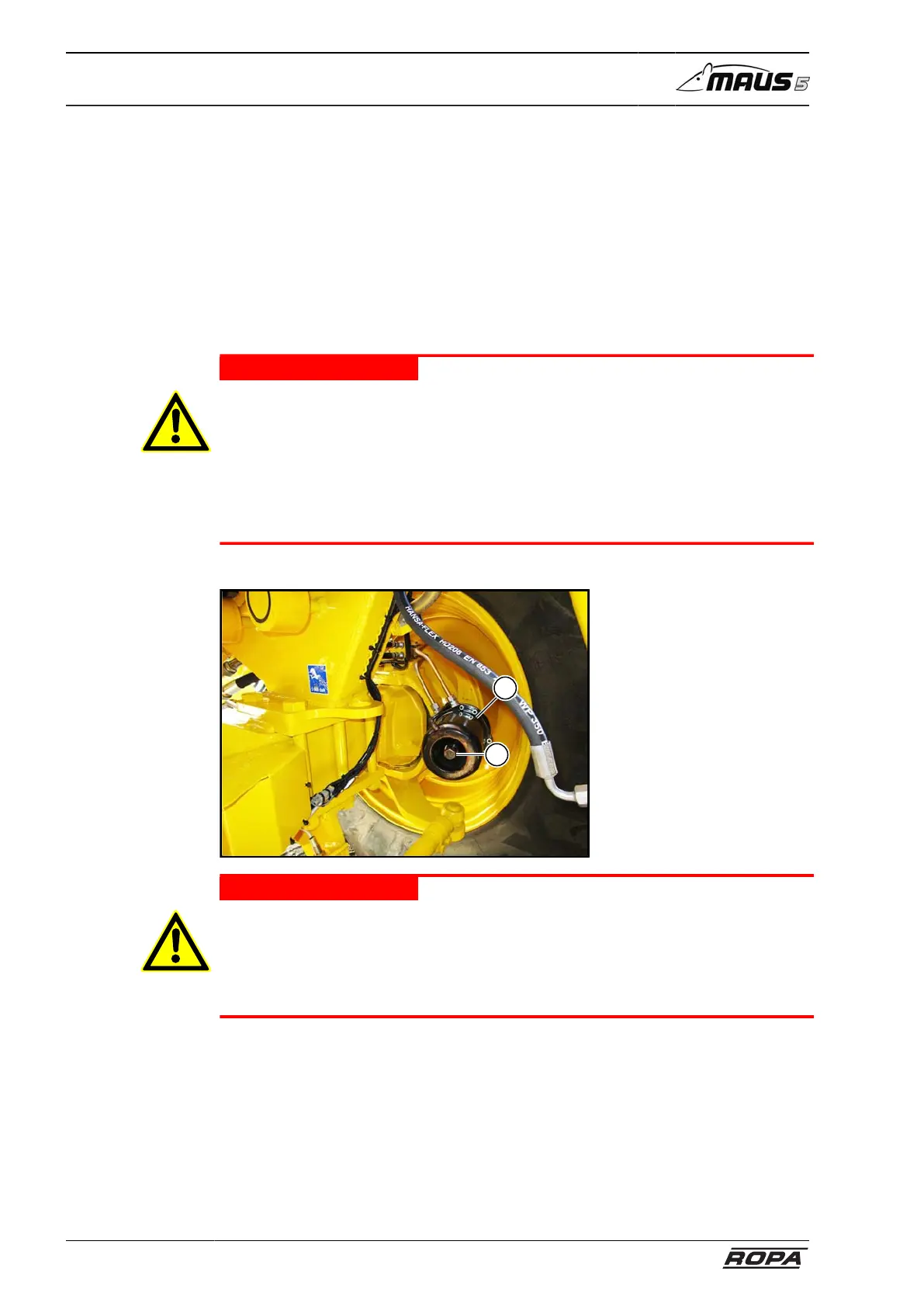
Deactivating the spring-loaded actuator:
1
4
DANGER
– Never park the vehicle unsecured with the spring-loaded actuator (1) released.
– Secure the vehicle against rolling away using sufficiently large wedges.
– Put in the driver's field of vision a distinctive sign with the inscription: "Danger!
Vehicle has no braking performance! The spring-loaded actuators are released".
– Keep the ignition key in a secure place.



 To Next Page