DMG 3200/3100/3000 – User Manual
Page 225 (306)
8.6 Universal Multiscreen Transcoder Configuration
The Universal Transcoder- Multiscreen can take up to four traditional broadcast services (HD
or SD) as inputs and convert/transcode these into several new services with profiles suitable
for reception by multiple different devices. These profiles normally differ in bitrate, resolution,
profile, level etc.
The Universal Transcoder- Multiscreen can take any conventional DVB service (HD/SD,
MPEG-2 or H264) as input. The module consists of four separate transcoder paths A, B, C
and D. All the profiles generated by the same path will be key frame aligned. If a single path
does not have enough processing power to generate the required profiles, the processing
power of several paths on the same module can be combined. Profiles generated by
combined paths will be key frame aligned.
When the Universal Transcoder- Multiscreen is configured and enabled, the profiles generated
will appear as MPTS inputs to the unit. These services can be output through an output
interface just like any other service.
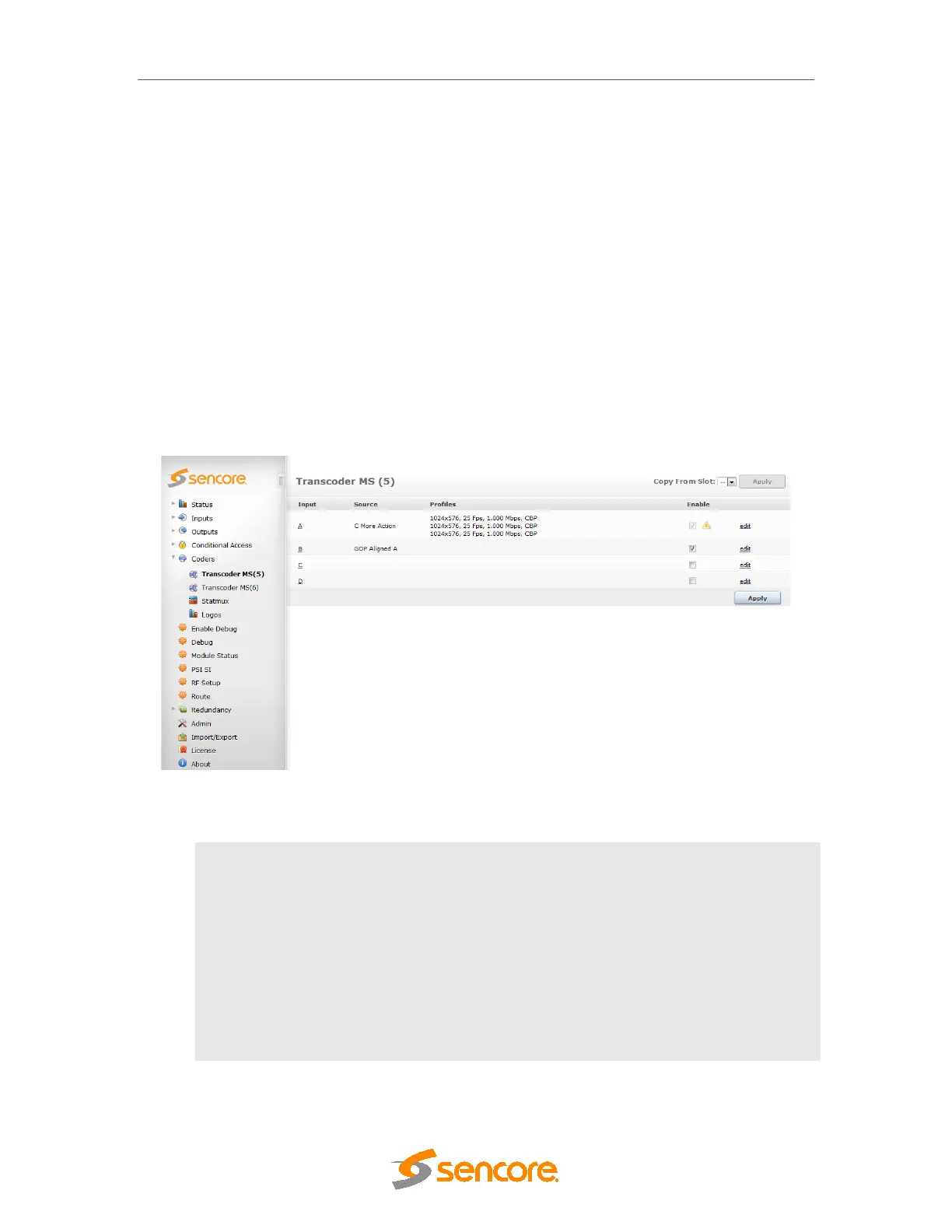
Figure 8.38 -
Universal Transcoder- Multiscreen status and configuration
Input
Clicking A, B, C or D displays detailed information about the input
services currently decoded by the transcoder path.
Source
Clicking on the service name for A, B, C or D shows the profiles
currently produced by the path.
Profiles
Specifies the profiles associated with that source.
Enable
Enables each path (A, B, C or D) individually.
Edit
Clicking Edit opens the detailed configuration page for each path.


 To Next Page