DMG 3200/3100/3000 – User Manual
Page 262 (306)
Another condition that will make the output card switch is when the card looses communication
with the MMI Card. This could happen when the card cannot login to the MMI, when the switch
is not working properly, or when the MMI card has been removed.
Digital Output Switch alarms
The table below lists the alarms displayed as a result of the switch:
Switched, reason: logout
The output module is logged out from the input card that hosts
the MMI – for this module, it also refers to internal link failure.
Switched, reason: No
bitrate
This alarm refers to input stream failure having caused the
switch
Switched, reason:
operator
This alarm refers to the operator having performed a manual
switch
There is a delay of 15 seconds before the alarm appears.
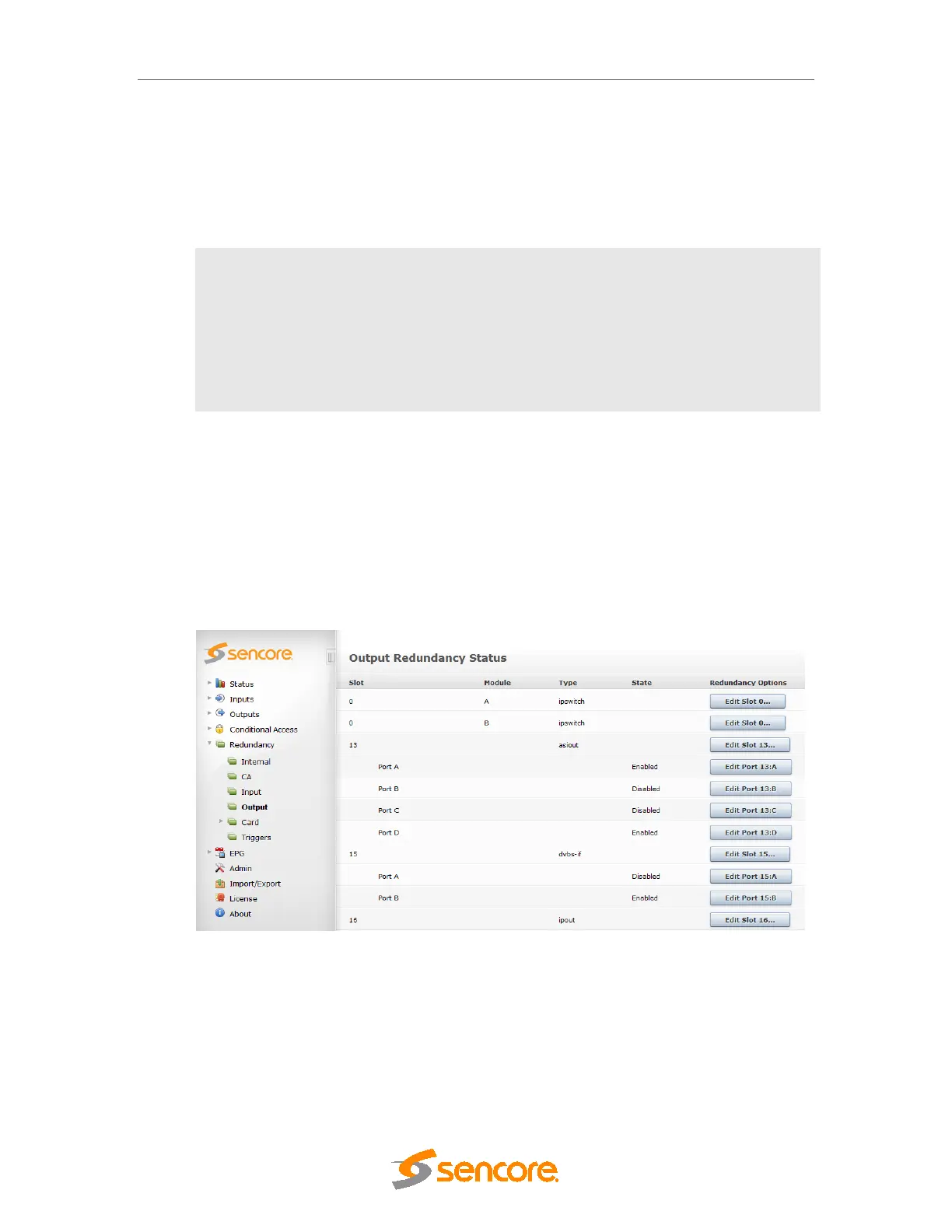
10.3 Output Redundancy
The output redundancy solution provided for the output cards is based on sending state events
to an external switch which can then perform the appropriate redundancy switch. For the IP
output card this event is the OSPF messages and for all other outputs the event is in the form of
an SNMP alarm. This allows external equipment and switches to be configured to switch to a
redundant source when these messages are received.
Figure 10.10 – Output Redundancy Status
10.3.1 Non-IP cards Output Redundancy
For non-IP output modules, when there is an error with the output, the system will signal an
‘Output Faulty’ alarm for the specified output port. This is then read by external equipment using
either the SNMP or SOAP interfaces in order to perform the redundancy switching. It is possible
to configure the following options:
• Configurable switch and Switchback delay - per card


 To Next Page