Power Allocation Introduction
3-3
Software Reference for SwitchBlade x3100 Series Switches (Power over Ethernet (PoE))
When detection and classification are complete, the full voltage is applied gradually (to minimize noise on the
line). This voltage is maintained until the PD is disconnected or an error condition is detected.
3.2.4 Power Allocation
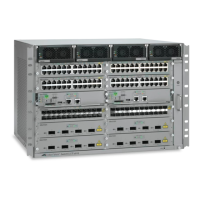
In Release 14.2 the SBx3112 will support two 1200W PoE PSUs for a total of 2400W of available PoE power.
This is enough to power a subset of the ports in some cases, but not all. When there is no longer sufficient PoE
power remaining to service new PDs, then the shelf is at capacity and some ports will not receive power. The
power allocation system is responsible for determining which ports will receive power.
Not all PDs draw the same amount of power. The amount of power that is actually needed determines the
device's class. There are currently 4 supported classes: Class 1 (4W), Class 2 (7W), Class 3 (15.4W), and Class
4 (30W). The number of supported devices per shelf depends on the classes of the devices in use.
The user also has the additional ability to set a power limit for a port manually. If the device tries to draw more
power than the user limit, the port will be shut down (just as if it had exceeded the port's classified power
limit). The port power limit, if set, is used in the power allocation algorithm instead of the PD class detected.
For instance, if the power limit is less than the PD class limit, then the power delta is still available for use by
other ports.
In addition to the shelf power limit (determined by the installed PoE PSUs) each card has an additional limit of
720W. The total amount of power consumed by the ports on a card cannot exceed this amount even if the shelf
has power available.
It is sometimes important to ensure that selected ports always receive power even when the system is at capac-
ity. To support this, each port is given a priority level: critical, high, or low (with low as the default). Critical pri-
ority ports are serviced first, then high and low (if enough power is available).
To ensure deterministic behavior, the slot and port number of each interface is also taken into account when
determining power allocation. Within each level, priority will be given to the lower number slots (and then
lower number ports). For example, if ports 1.1, 2.1, and 1.3 were all low priority and higher priority ports
needed power, then 2.1 would be disabled first followed by 1.3 then 1.1. This is mainly for deterministic behav-
ior and should not be relied upon by the customer as a means of controlling which ports receive power.
In order to ensure that power distribution is handled correctly and to prevent ports from bouncing as devices
come up, only two PDs per card will be allowed to come up at a time.
If a PD is removed from a port (or the PoE feature on that port is disabled) when the system is at capacity, then
the next highest priority port that is not already getting power will now receive power.
If a PD is connected to a port when the system is at capacity and the new port is a higher priority than other
ports already getting power, then the lowest priority port(s) will lose power and the newly connected port will
receive power.
The determination of whether or not a port is capable of being powered is determined entirely by the PoE state
and the presence on the port of a supported PD. The port's administrative state, as well as the state of the PD’s
Ethernet, has no effect. Provided that the connection to the PD is maintained, a port that is providing power will


 To Next Page
 Loading...