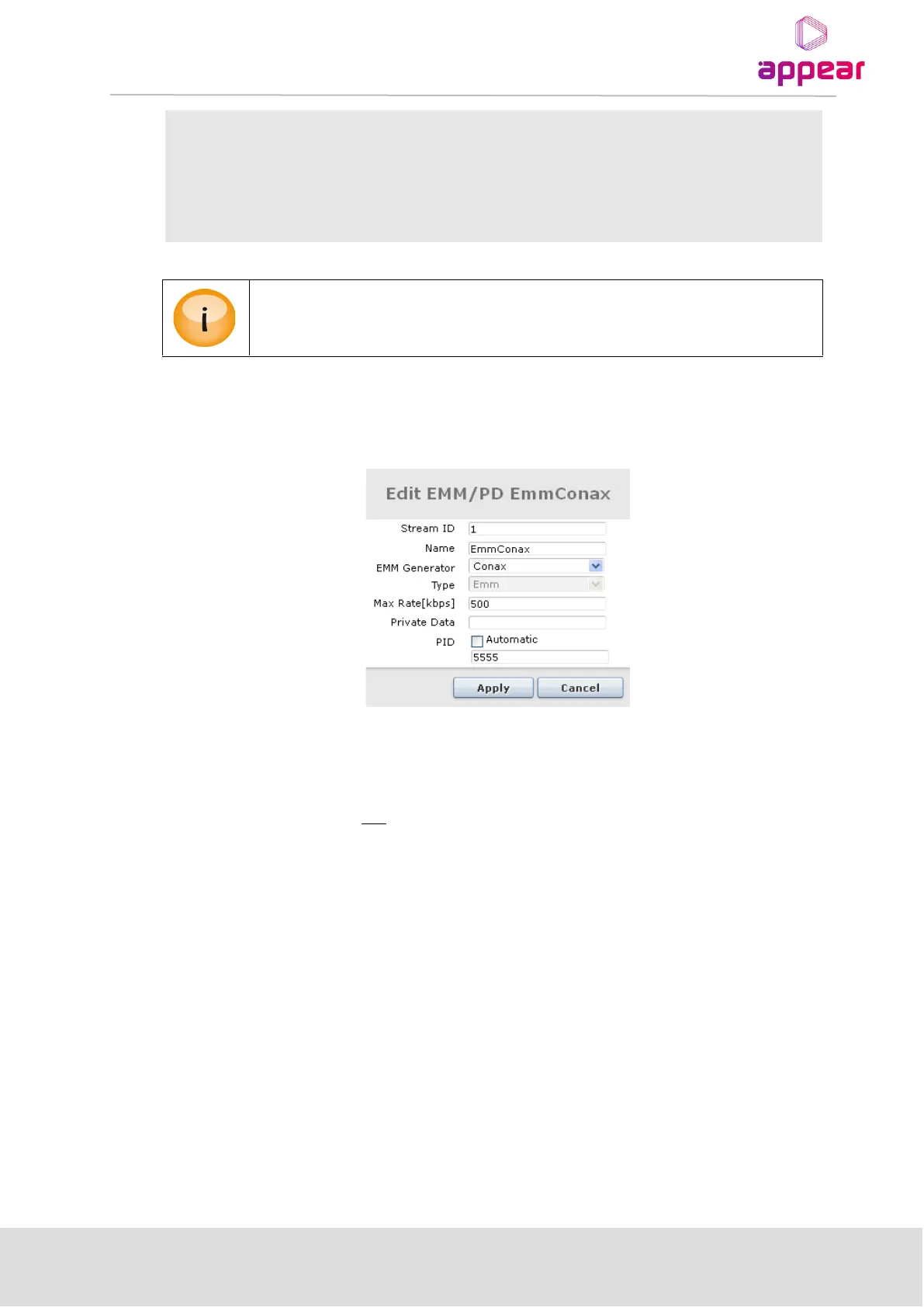
For EMM transfer over UDP configured, then the UDP port must be defined when
configuring the actual EMM
At this point, the EMM/PD stream is defined and the CA system is able to push content to the
SCS module. However, the EMM/PD is still not associated to any output. Refer to the Output
Configuration chapter for details on how to associate EMMs to outputs.
To change an, EMM/PD configuration click on the existing EMM/PD entry and enter the new configuration.
6.4.1.7 Support for Multiple CA Systems (Simulcrypt)
The scrambling solution supports four CA systems simultaneously. No particular configuration is required for
this. Simply define the appropriate ECMGs, ECMs, EMMGs and EMM connections required. The system to be
used for actual scrambling is defined as part of the output configuration process.
When configuring services that are to contain information for multiple CA systems, the following must be done:
• The corresponding ECMs for each service / CA system must have identical SCG ID values
• All ECMs must be assigned to the service
• If applicable, valid EMMs must be added to the output for each CA system
6.4.1.8 Configuring an EIS service Channel
The Event Information Scheduling (EIS) interface is a scheduling interface for associating ECMs to outputs. The
configuration of the EIS is similar to setting up an ECMG/EMMG connection.
The EIS interface provides the following functions.
• Create a new ECM
• Modify an ECM’s access criteria



 To Next Page