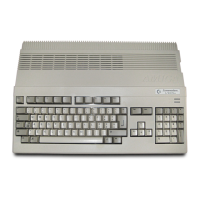
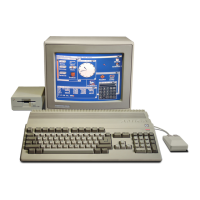
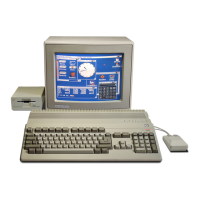
• The Keyboard, on the main unit, resembles a typewriter keyboard
with some extra keys. The keyboard
is
used to enter commands and
data and to respond to
prompts (messages) sent from the computer.
With 94 keys, the Amiga keyboard
is
among the most complete
keyboards available
in
the microcomputer field . See Appendix C for
details on keyboard layout and !Unctions.
Note on the Keyboard:
Your Amiga keyboard may have a Commodore key replacing the
Amiga key to the left
of
the space bar. These keys are functionally
identical, differing only
in
what is painted on the key cap. All
references
in
sof
tware package
in
structions to the left Amiga key are
valid for the Commodore key. All references to the Commodore key
apply to the left Amiga key.
• The
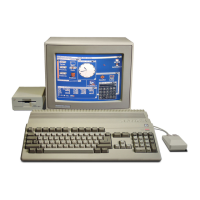
Disk Drive
is
lo
ca
ted on the right side
of
the main unit. When
you insert the
software disks into the disk drive, the computer can
read information
from them and write information to them.
• The
Mouse
is
a small hard ball enclosed
in
a palm-sized housing.
You use the mouse to move a pointer from place to place on the
display screen
in
order to select Amiga functions and capabilities.
The mouse
is
connected to one
of
the ports on the main unit.
• The
Software Disks are
3'12
inches square and contain instructions
that tell the computer what to do.
• The
Power Supply has two cables. One cable plugs into a port on the
m
ai
n unit; the other cable plugs into an electrical receptacle. The Onl
Off
switch for the computer is located on the power supply.
•
The
Monitor displays information
in
response to actions taken
by
you
or the computer. The monitor (which may be one
of
several types,
and which
is
not included as part
of
the Amiga 500 package)
is
connected to the back
of
the console unit.
See Chapter 2 for setup and connection
in
structions.
Introducing the Amiga 500
\
-3






 To Next Page