Introducing The Amiga 500
The Amiga
500's
spectrum
of
capabilities
is
wide, sophisticated, versatile and
yet affordable. And all this power and sophistication have been made so accessi-
ble, so easy to control that even a computer novice can be
up
and running with a
minimum
of
effort.
The Amiga 500 retains all the features that inspired reviewers to dub the original
Amiga 1000 " the Maserati
of
microcomputers" - high speed/high efficiency
processing; superb graphic and video resources; advanced stereo sound and
music capabilities; the ability to perform a number
of
tasks simultaneously
(multitasking operation); a unique file structure that allows programs to exchange
data
of
various types (program code, graphics, sound); easy expandability; and
more.
In
the Amiga 500, these features are enhanced and new ones are added.
For example, the Amiga 500 comes equipped with 512 K
of
RAM, expandable
to a full megabyte internally (by adding the A50
I memory expansion unit) . All
this RAM is directly accessible, eliminating the time that other micorcomputers
must spend
in
indirectly accessing expansion RAM (e.g. , by using a RAM disk
scheme). This gives the Amiga a considerable advantage
in
processing speed.
Later
in
this chapter there is a section describing the major features
of
the
Amiga 500. These descriptions demonstrate that
in
selecting the Amiga 500 you
have chosen one
of
the most advanced microcomputers available today.
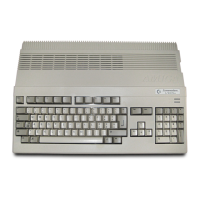
The Amiga 500 combines a number
of
components-keyboard,
disk drive, and
CPU-in
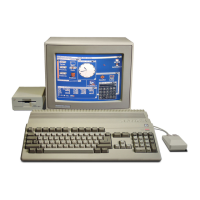
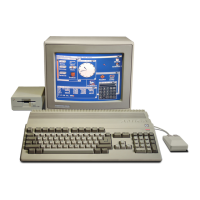
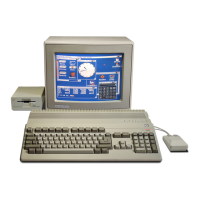
one unit, called the main unit. A typical Amiga 500 system consists
of
the main unit and additional components. The capsule descriptions following
identify these components and describe their basic functions. Chapter 2 tells how
to connect all the components so you can begin computing .
• The
Main Unit contains the computer circuitry, the keyboard, and a
built-in
31j2 inch floppy disk drive. The main unit houses the CPU
(central processing unit) and other microchips containing memory
and processing circuitry
(e.g.,
the sound and graphics chips). On the
bottom
of
the main unit there
is
an expansion slot into which you can
insert optional additional memory. On the back, there are several
jacks, connectors and ports, into which you can plug peripherals
(optional external equipment, like printers, modems, and extra disk
drives).
\-2
Introducing the Amiga 500







 To Next Page