TROUBLESHOOTING
U–73
U
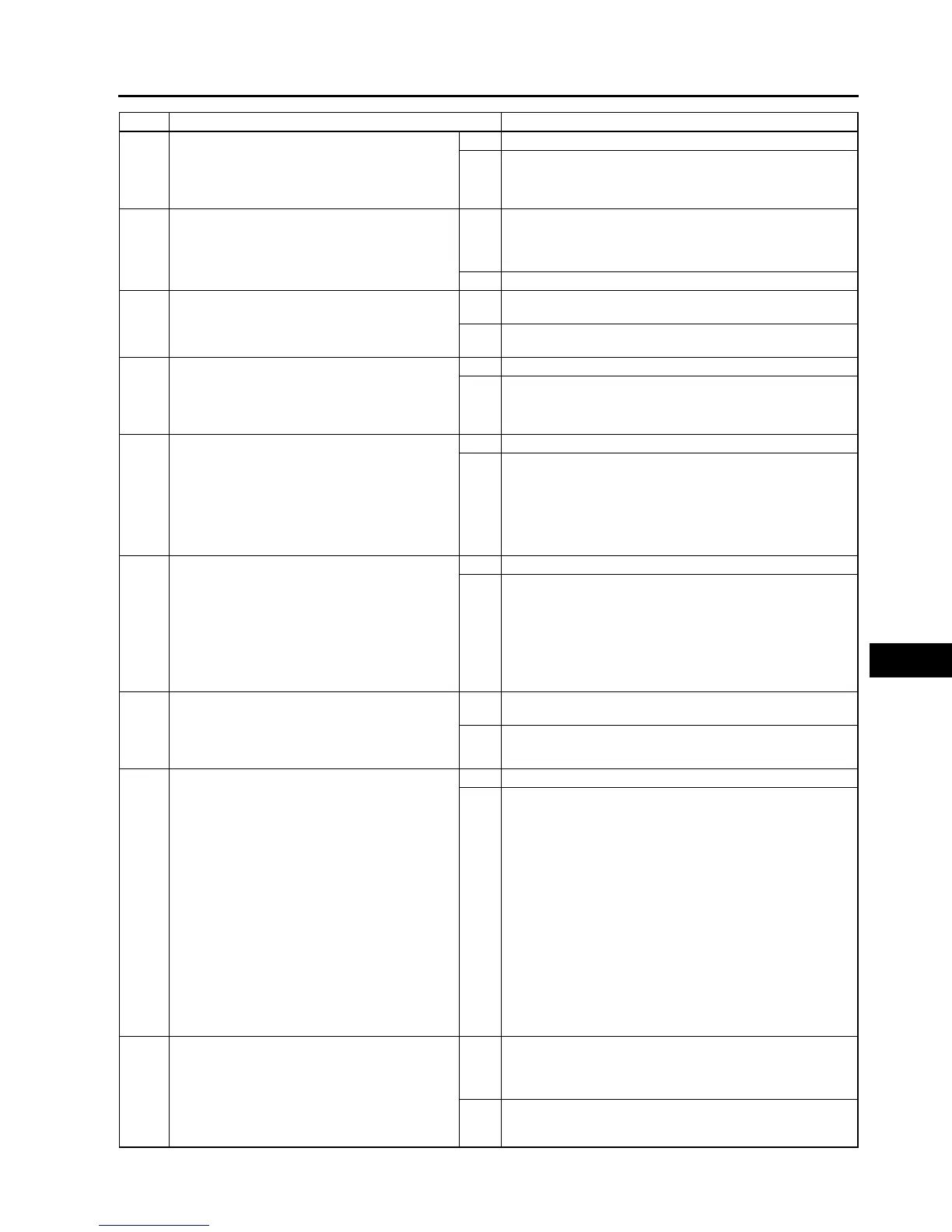
3 CHECK TO SEE WHETHER MALFUNCTION
IS IN BLOWER UNIT INTAKE AND
CONDENSER OR ELSEWHERE
• Are refrigerant high-pressure and low-
pressure values both high?
Yes Go to next step.
No Go to Step 6.
4 INSPECT BLOWER UNIT INTAKE
• Is blower unit intake clogged?
Yes Remove obstruction, then go to Step 20. (If air does not
reach evaporator within A/C unit, heat exchange does not
occur and refrigerant pressure becomes high.
Therefore, removal of obstruction is necessary.)
No Go to next step.
5 INSPECT CONDENSER
• Inspect condenser.
(See U–24 CONDENSER INSPECTION)
• Is it okay?
Yes Adjust refrigerant to specified amount, then go to Step 20.
(Excessive amount of refrigerant.)
No Replace condenser, or repair and clean condenser fins,
then go to Step 20.
6 CHECK TO SEE WHETHER MALFUNCTION
IS IN EXPANSION VALVE, RECEIVER/DRIER
AND REFRIGERANT LINES OR ELSEWHERE
• Are refrigerant high-pressure and low-
pressure values low?
Yes Go to next step.
No Go to Step 14.
7 CHECK TO SEE WHETHER MALFUNCTION
IS IN EXPANSION VALVE AND RECEIVER/
DRIER OR ELSEWHERE
• Immediately after A/C compressor operates,
does refrigerant high-pressure value
momentarily rise to correct value, then fall
and stay below it? (Is there negative
pressure on low-pressure side?)
Yes Go to next step.
No Go to Step 10.
8 CHECK TO SEE WHETHER MALFUNCTION
IS IN EXPANSION VALVE OR RECEIVER/
DRIER
• Turn A/C switch off and let air conditioner
stop for 10 minutes.
• Start engine.
• Turn both A/C switch and fan switch on.
• Does malfunction occur after A/C
compressor turns on?
Yes Go to next step.
No Replace condenser and vacuum refrigerant line more than
30 minutes by vacuum pump, add refrigerant to specified
level, then go to Step 20. (Since water has intermixed in
receiver/drier and it is saturated, replacement is necessary.)
9 VERIFY THAT EXPANSION VALVE HEAT-
SENSING TUBE WITHIN A/C UNIT IS
POSITIONED SECURELY AND CORRECTLY
• Is expansion valve heat-sensing tube within
A/C unit securely installed in proper position?
Yes Replace expansion valve, then go to Step 20. (Since valve
closes too much, replacement is necessary.)
No Install heat-sensing tube securely in proper position, then go
to Step 20.
10 INSPECT REFRIGERANT LINES
• Inspect refrigerant lines.
— Is piping free of damage and cracks?
— Are piping connections free of oil grime?
(Visual inspection)
— Are piping connections free of gas
leakage?
— Are piping installation points on
condenser free of gas leakage?
— Are piping installation points on receiver/
drier free of gas leakage?
— Are piping installation points on A/C
compressor free of gas leakage?
— Are piping installation points on A/C unit
free of gas leakage?
— Perform gas leak inspection using gas
leak tester.
• Are above items okay?
Yes Go to next step.
No If piping or A/C component(s) are damaged or cracked,
replace them.
Then go to Step 20.
If there is no damage, go to Step 13.
11 INSPECT EVAPORATOR PIPING
CONNECTIONS IN A/C UNIT FOR GAS
LEAKAGE
• Are piping connections for evaporator in A/C
unit free of gas leakage?
Yes If the vane makes a noise, add 10 ml {10 cc, 0.34 fl oz} of
compressor oil to the A/C compressor. Verify that the noise
is no longer heard.
Adjust refrigerant to specified amount, then go to Step 20.
No If piping is damaged or cracked, replace it.
Then go to Step 20.
If there is no damage, go to next step.
STEP INSPECTION ACTION



 To Next Page