ENGINE COOLANT, RADIATOR CAP
E–5
E
the pressure escapes.
• When you are sure all the pressure is gone, press down on the cap using the cloth, turn it, and
remove it.
1. Inspect the coolant level.
2. Remove the radiator cap.
3. Clean the mounting surface of the rediator cap and the upper radiator hose.
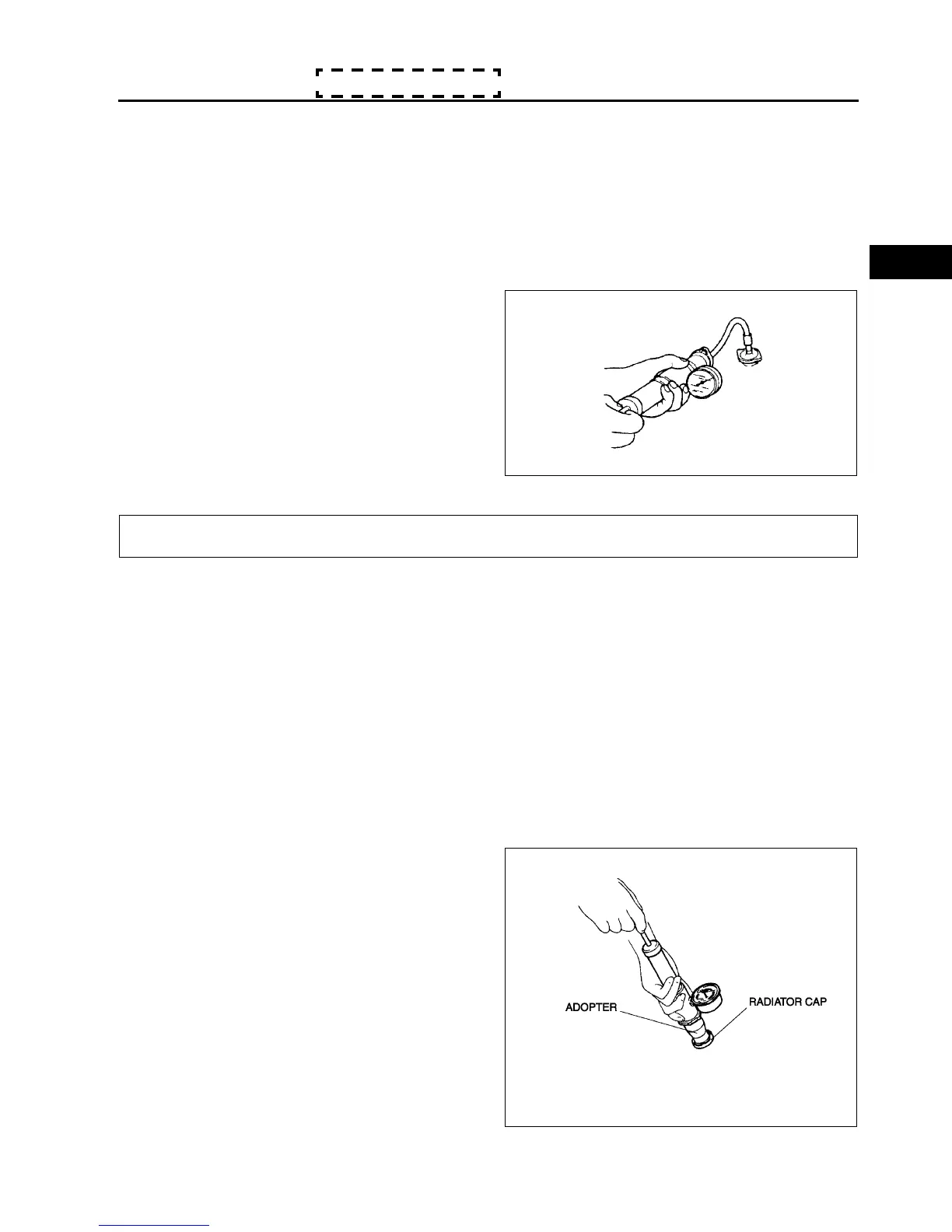
4. Connect a radiator cap tester and the radiator cap tester to the reservoir filler port.
5. Apply specified pressure to the radiator.
Pressure
127 kPa { 1.3 kgf/cm
2
, 18 psi}
6. Verify that the pressure is held.
• If not, inspect the system for coolant leakage.
— If the coolant leaks from the upper hose
attachment part, replace the upper hose
and the clamp.
— If the coolant leaks from the main body of
the radiator (caulking part), replace the
radiator.
End Of Sie
RADIATOR CAP INSPECTION
A6E361415201W01
Warning
• Never remove the radiator cap while the engine is running, or when the engine and radiator are
hot. Scalding coolant and steam may shoot out and cause serious injury. It may also damage the
engine and cooling system.
• Turn off the engine and wait until it is cool. Even then, be very careful when removing the cap.
Wrap a thick cloth around it and slowly turn it counterclockwise to the first stop. Step back while
the pressure escapes.
• When you are sure all the pressure is gone, press down on the cap using the cloth, turn it, and
remove it.
1. Clean the radiator cap negative pressure valve and tha sealed part.
2. Inspect the crack or turn over on sealed of the radiator cap.
• If not as specified, repace the radiator cap.
3. Fill the radiator cap test adopter with the water or the engine coolant to the full level and attach the radiator cap
to the adapter.
4. Hold the radiator cap downward and apply
pressure gradually. Verify that the pressure
become held for 10 s within the specification.
• If the pressure will not stable within the
specification, replace the radiator cap.
Pressure
113—142 kPa
{ 1.1—1.4 kgf/cm2, 15—20 psi}
AME3612W003
RADIATOR CAP
AME3614W001



 To Next Page