TROUBLESHOOTING
F–201
F
End Of Sie
NO.9 FAST IDLE/RUNS ON
A6E398018881W11
Diagnostic procedure
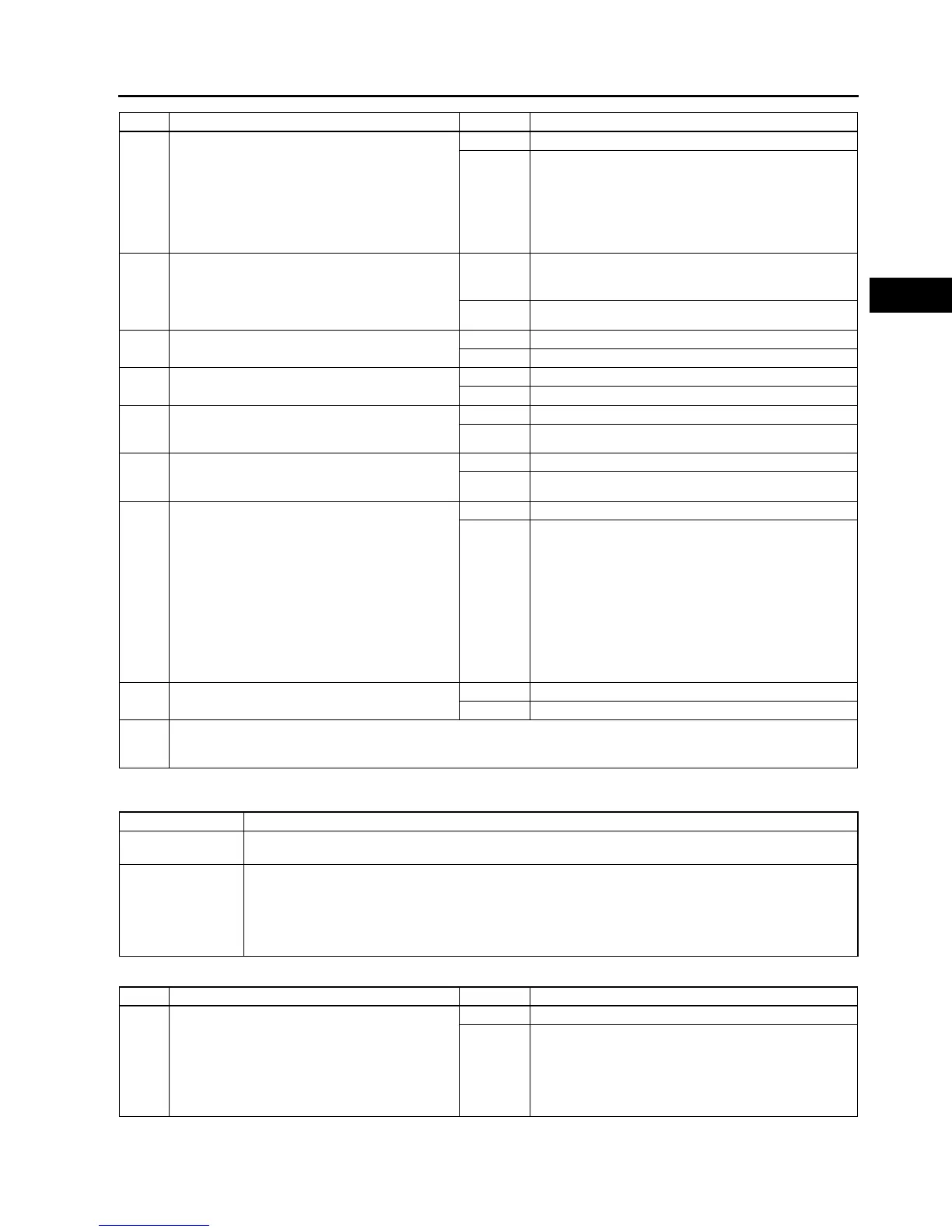
13 Connect WDS or equivalent to DLC-2.
Start the engine and run it at idle.
Access O2S11 PID.
Is O2S11 PID okay?
• More than 0.45 V when accelerator pedal is
suddenly depressed: rich condition
• Less than 0.45 V during fuel cut: lean
condition
Yes Go to next step.
No Inspect and repair or replace faulty HO2S, harness,
connector or terminal, then go to next step.
14 Disconnect vacuum hose between purge
solenoid valve and intake manifold from purge
solenoid valve side.
Plug opening end of vacuum hose. Start engine.
Does engine condition improve?
Yes Inspect if purge solenoid valve sticks open
mechanically.
Inspect EVAP control system.
No Go to next step.
15 Remove and shake PCV valve.
Does PCV valve rattle?
Yes Go to next step.
No Replace PCV valve.
16 Inspect for restriction in exhaust system.
Is there any restriction?
Yes Inspect exhaust system.
No Go to next step.
17 Visually inspect CMP sensor and teeth of
camshaft.
Are CMP sensor and teeth of camshaft okay?
Yes Go to next step.
No Replace malfunctioning parts.
18 Inspect engine condition while tapping EGR
valve housing.
Does engine condition improve?
Yes Replace EGR valve.
No Go to next step.
19 Note
• The following test should be performed for
vehicles with variable valve timing control
system. Go to next step for vehicles witout
variable valve timing control system.
Inspect variable valve timing control system
operation.
(See F–239 Variable Valve Timing Control
System Operation Inspection.)
Does variable valve timing control system work
properly?
Yes Go to next step.
No Repair or replace malfunctioning parts.
20 Is engine compression correct? Yes Inspect valve timing.
No Inspect for causes.
21 Verify test results.
• If okay, return to diagnostic index to service any additional symptoms.
• If malfunction remains, replace PCM.
STEP INSPECTION RESULTS ACTION
9 FAST IDLE/RUNS ON
DESCRIPTION
• Engine speed continues at fast idle after warm-up.
• Engine runs after ignition switch is turned off.
POSSIBLE CAUSE
• ECT sensor malfunction
• Air leakage from intake-air system
• Throttle body malfunction
• Accelerator cable free play misadjustment
• Cruise control cable misadjustment
• Improper load signal input
STEP INSPECTION RESULTS ACTION
1 Connect WDS or equivalent to DLC-2.
Access ECT PID.
Start and warm up engine to normal operating
temperature.
Is ECT PID reading between 82—112°C {180—
234°F}?
Yes Go to next step.
No ECT PID is higher than 112°C {234°F}:
Go to symptom troubleshooting "No.17 Cooling system
concerns - Overheating".
ECT PID is less than 82°C {180°F}:
Go to symptom troubleshooting "No.18 Cooling system
concerns - Runs cold".



 To Next Page