Chapter 13. Active Multi-way Speakers
3. Measurement technique is usually more demanding for the bi-amp and tri-amp
configurations. In cases such as when measuring a small two-way speaker, a
sufficiently accurate correction and crossover can be obtained with indoor
measurement. Otherwise, unless there is access to facilities such as an anechoic
chamber, it may be necessary to:
a. Take measurements outside (or in a large structure such as a gymnasium), and
b. Use a raised platform to extend the time to the first reflection. (In this case,
ensure that the platform does not extend past the front of the speaker, as that
will create its own reflection.)
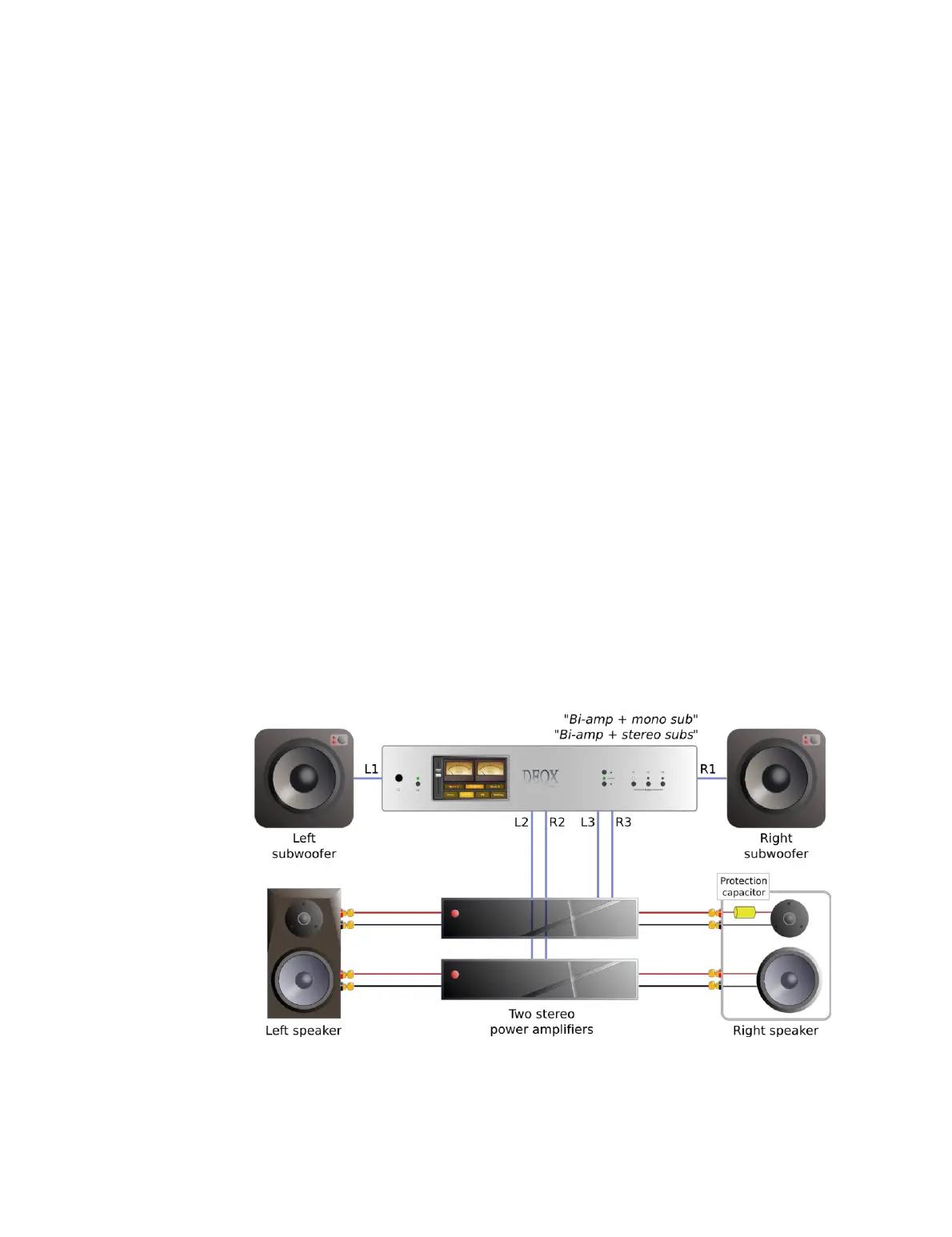
The following sections describe the main active speaker configurations as well as hybrid
active-passive configurations. Take careful note of the output connections (L1 etc.) on
each diagram. (For configurations using more than one DEQX, see Chapter 14.)
13.1.2 Active two-way speaker
Figure 5 shows the physical connections for an active two-way speaker. If stereo
subwoofers are used (as shown in the diagram), set the speaker configuration mode to
“bi-amp with optional stereo subwoofers.”
If a single subwoofer is used, connect it to L1 only and set the speaker configuration
mode to “bi-amp with optional mono subwoofer.”
If no subwoofer is used, the speaker configuration mode can be set to either of the two
bi-amp modes and the subwoofer channels left disabled.
Figure 5. Active two-way speaker



 To Next Page