Chapter 13. Active Multi-way Speakers
13.1.4 Hybrid active-passive speakers
With speakers that bring out separate internal crossover networks to the binding posts,
the DEQX can be used to implement a hybrid active-passive speaker. The existing
passive crossover can be left untouched to split the frequency range; alternatively, the
DEQX can be used to override the passive crossover (with some limitations).
In the case of a two-way speaker, the physical connections are as shown in Figure 5, but
the tweeter and woofer each retain their own internal passive filter network. Calibration
proceeds in much the same manner as for an active two-way, but the crossover
frequency will need to be set at or somewhere near the crossover frequency defined by
the passive crossover. The DEQX will compensate for the frequency and phase response
of the passive crossover and still realize an ideal linear-phase crossover.
In the case of a three-way speaker with three pairs of binding posts, connections and
calibration are similar to an active three-way speaker (page 108). In other cases, the
speaker may have two pairs of binding posts, with the mid-tweeter network brought
out to one pair and the woofer network to the second pair. If so, there are two options:
x If the woofer-mid crossover frequency is high enough (at least 300 Hz), it may be
possible to use a bi-amp speaker configuration mode as described above.
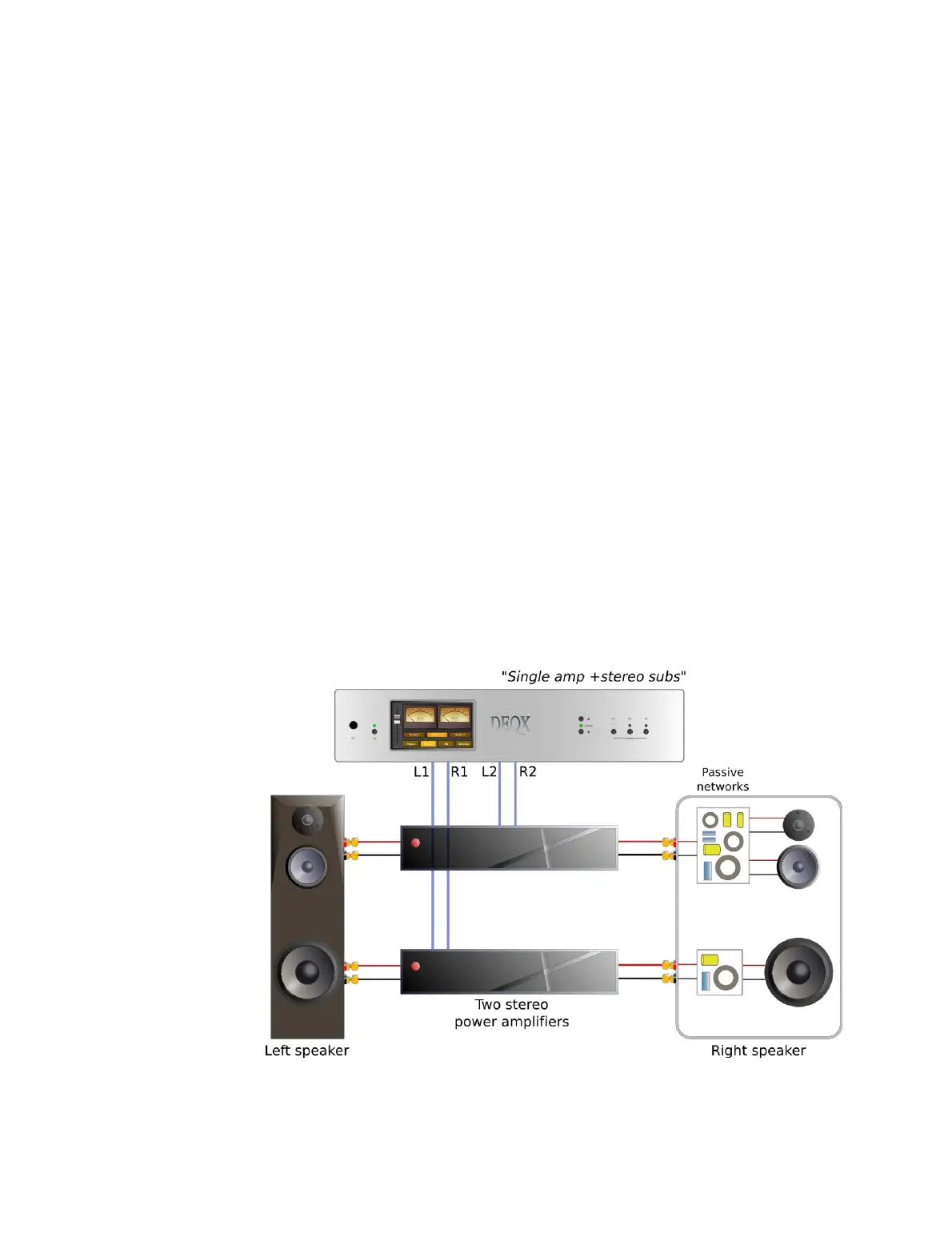
x Otherwise, use the “single amp with optional stereo subs” speaker configuration
mode, with connections as shown in Figure 7 below. Some care will be needed if using
limit filters between the woofer and mid-tweeter networks.
Figure 7. Hybrid active-passive three-way speaker



 To Next Page