DEQX User Manual
13.5.2 Correction and limit filters for subwoofers (two-way)
If using subwoofers with a two-way active speaker (Figure 5 on page 107), you will need
to measure and calibrate the subwoofers as described in Chapter 8, and configure limit
filters as described on pages 77 and 78.
After uploading the configuration to the DEQX (“Save All to DEQX”), you can then
perform room measurement, subwoofer integration, and room correction as described
in Chapters 10 through 12.
13.5.3 Correction and limit filters for woofer-mid crossover (three-way)
With a three-way active speaker using the “bi-amp with optional stereo subwoofers”
speaker configuration mode (as per page 108), the crossover between the woofer and
midrange is implemented with limit filters. Since this crossover is usually at a higher
frequency than a subwoofer crossover, linear phase filters are typically used.
First, calibrate the woofers using a nearfield measurement as for subwoofers
(Chapter 8). Alternatively, you can use an in-room calibration for the woofers, as
described on page 121. Load the correction filter or filters in the Filter Properties dialog
box of the “Left Sub” and the “Right Sub” (remember that these are actually the
woofers).
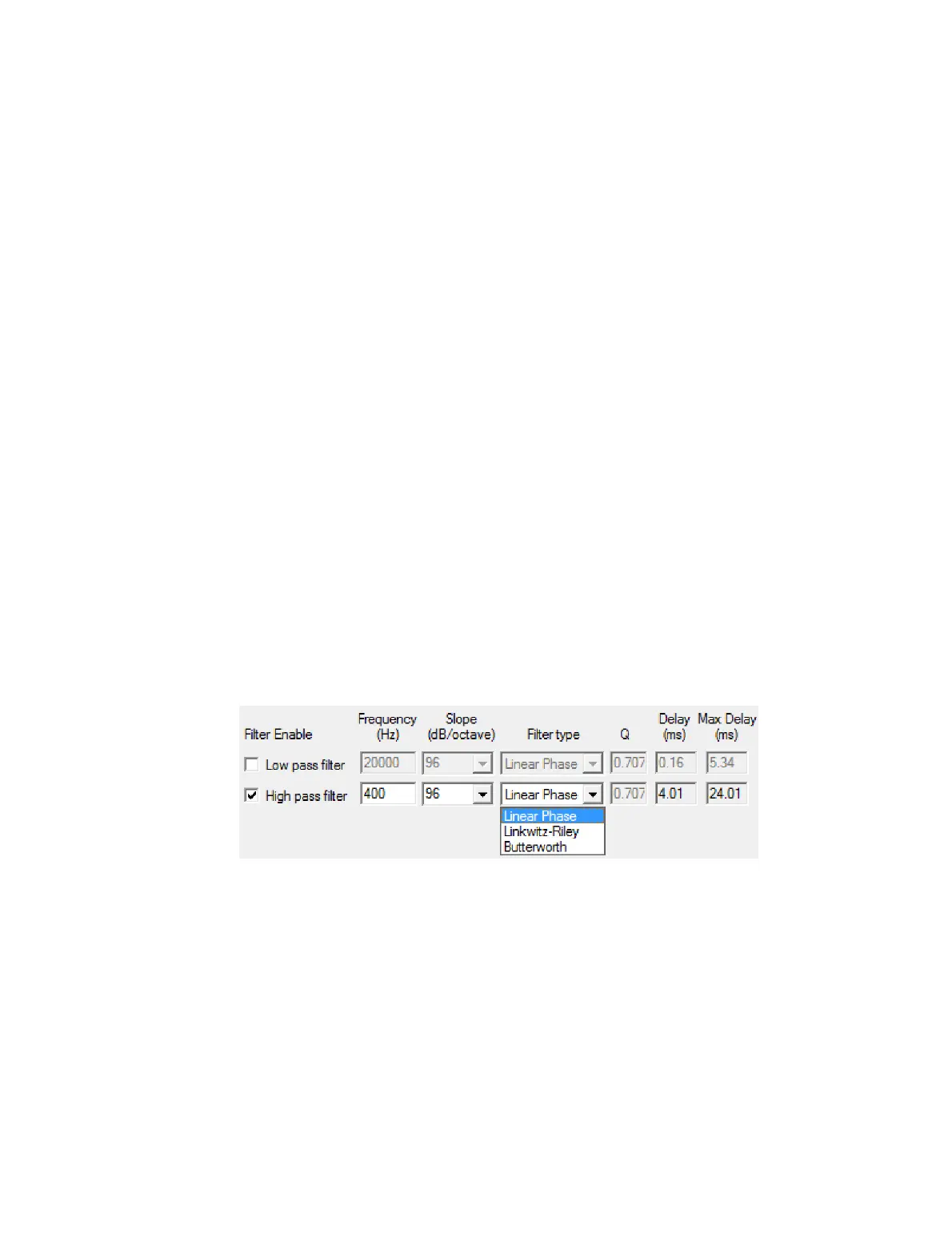
To set up a linear phase crossover between the woofer and midrange, open the Filter
Properties dialog of the left speaker. On the Limit Filters tab, enable the high pass filter.
Enter the crossover frequency in the Frequency field, then drop down the Filter type
menu and select “Linear Phase”:
Then drop down the Slope menu and select the desired slope. Typically, a slope
between 48 and 96 dB/octave works well, but higher slopes can be auditioned if desired.
After closing the Filter Properties dialog of the left speaker, repeat for the right speaker.
Then set up matching low pass filters for the two woofers. While the low pass filter on
the woofer will usually have the same slope and frequency as the high pass filter on the
midrange, an asymmetric crossover can be useful in some cases to account for the
acoustic responses of the drivers near the crossover frequency.



 To Next Page