Chapter 1o. Room Measurement
10.7 ASSESS THE INITIAL MEASUREMENT
The measurement taken in the center of the listening area can be examined to confirm
suitable speaker and subwoofer locations. It can also be used to confirm that the
microphone has in fact been placed in the center of the listening area.
The procedures in this section are optional, but you may find that you get a better end
result by using them. To proceed, start by opening the room measurement taken at the
center of the listening area in a new data viewer.
You will need to zoom in on the plots to view them more clearly. To do so,
click the zoom icon in the toolbar and then either click on the graph or drag
out a rectangle around the area of interest. For more detailed information
on how to work with the measurement plots, see Chapter 16.
10.7.1 Speaker location
When a DEQX is used in your system, the optimal speaker (and subwoofer) placement
may be different to what you have previously found. Without the DEQX, you may have
(even unknowingly) chosen a speaker location and listening position that tends to result
in low output at low frequencies, in order to avoid “boominess.”
With a DEQX’ capability to linearize the speaker/subwoofer response and address room
modes, the optimum speaker and listening positions are often those that tend to excite
room modes more. The peaks can be addressed by the DEQX, with a better end result
and less risk of overdriving amplifiers.
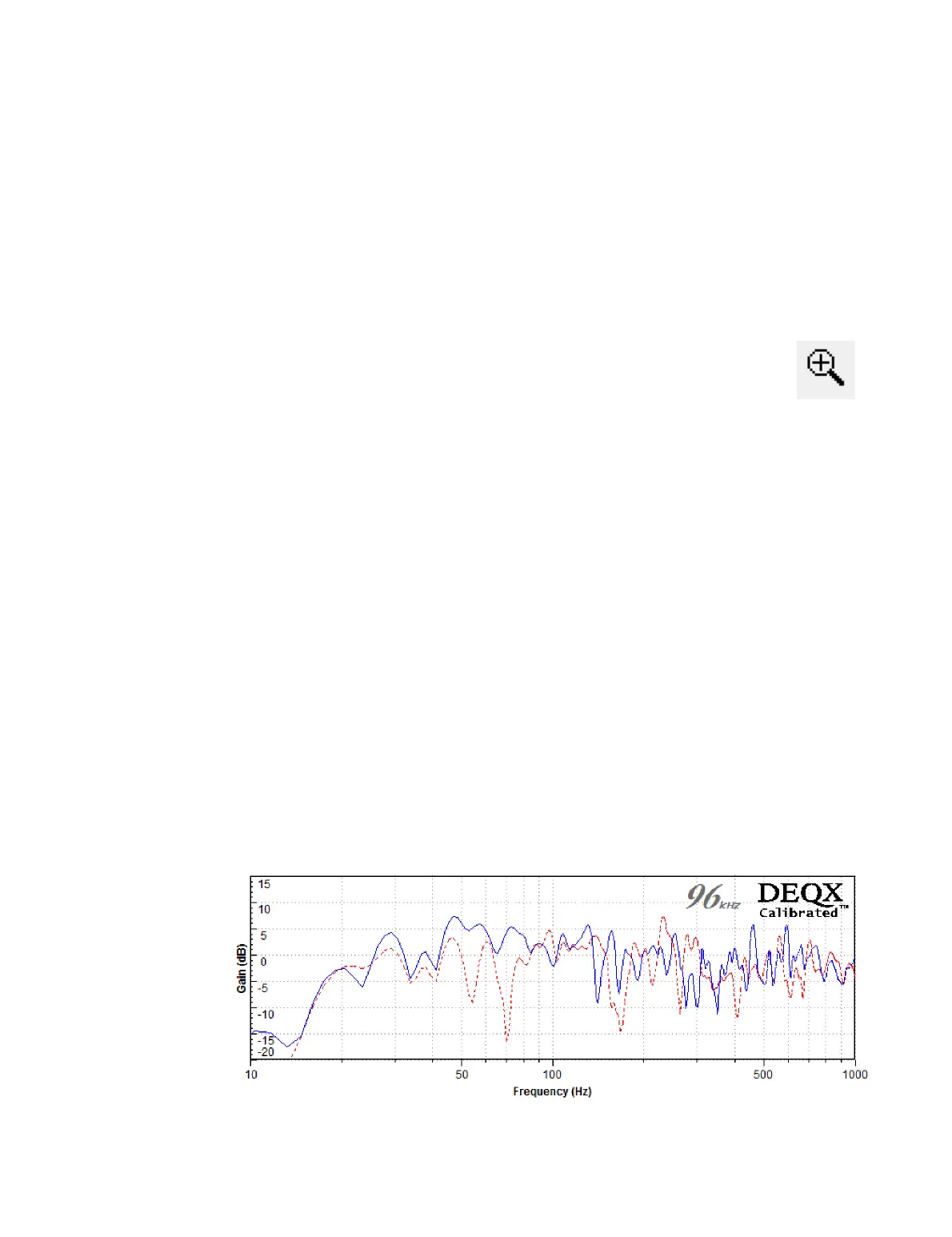
The example below shows the measurements of two speaker and listening location
combinations in the same domestic living room. In both cases, the microphone was
approximately 2.4 m (8 feet) from the speaker. The response shown in blue is likely to
lead to a better end result than the response shown in dotted red, which has significant
“suck-out” in the 50 – 75 Hz and 160 – 180 Hz ranges.



 To Next Page