Chapter 13. Active Multi-way Speakers
It is not required to use linear-phase filters for the woofer-mid crossover. At lower
frequencies, the delay of linear-phase filters increases significantly, so a Linkwitz-Riley
filter may be preferable, either to avoid video sync issues or because the Max Delay
limit is reached with a linear phase filter (see below).
The Filter type drop-down offers three choices:
Linear Phase
Linear phase filters have no phase shift across the audio band. Filter slopes can be
set in 6 dB increments from 48 to 300 dB/octave.
Linkwitz-Riley
Linkwitz-Riley crossover filters are conventional (non-linear phase) filters with
phase shift above and below the roll off frequency and with symmetrical vertical
lobing. Filter slopes can be set in 12 dB increments from 12 to 120 dB/octave.
Butterworth
Butterworth crossover filters are conventional (non-linear phase) filters with
phase shift above and below the roll off frequency. Filter slopes can be set in 6 dB
increments from 6 to 120 dB/octave.
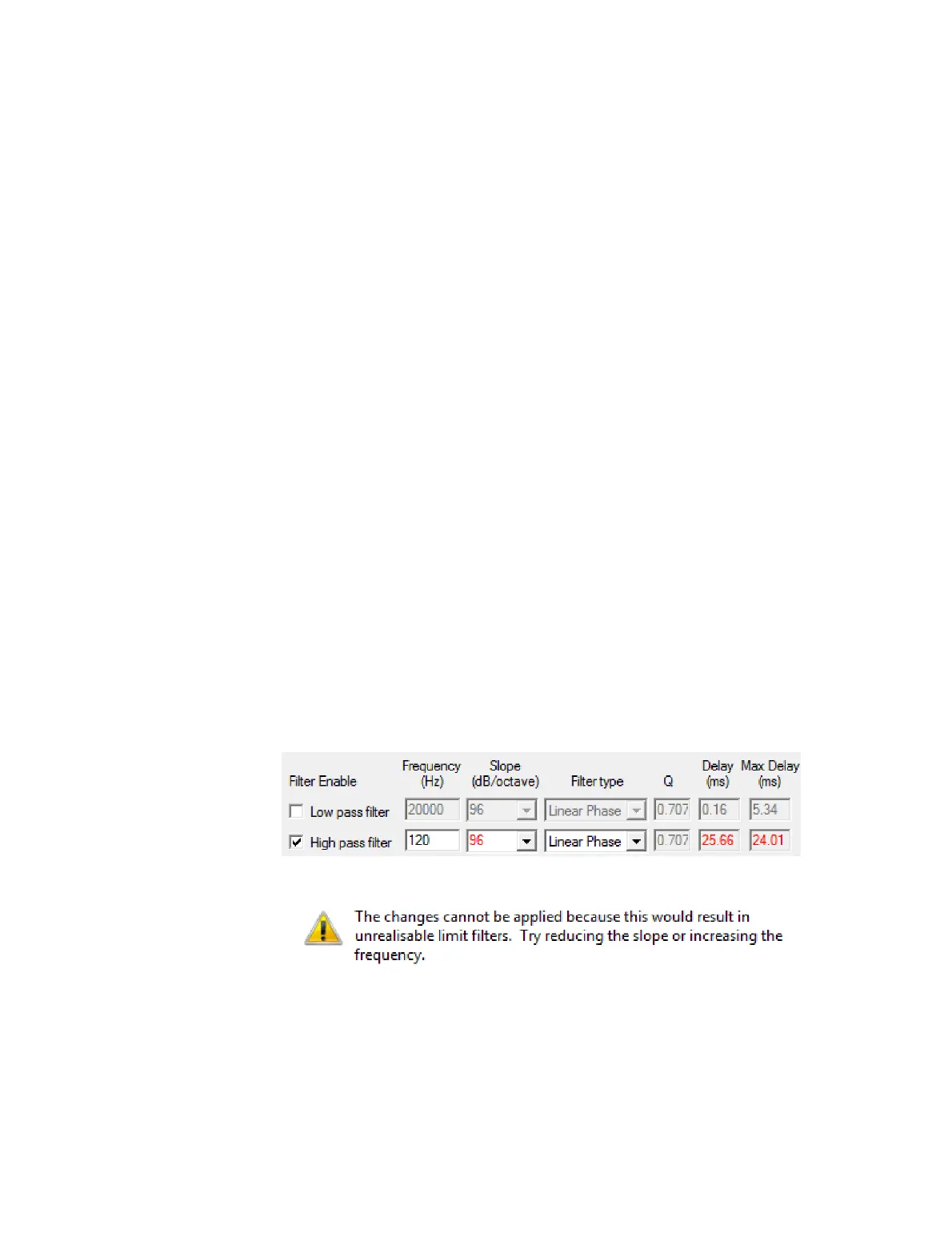
Note that the filter slope is limited by the maximum allowed delay and the type of filter
chosen. The maximum allowed delay is displayed in the dialog (24.01 ms in the example
shown below) and is determined by the delays introduced by all currently selected
filters. The Slope drop-down menu will always reflect the allowable set of filter slopes
for a given filter type and frequency.
If you manually enter an unrealizable combination of frequency, slope, and crossover
type, the fields are displayed in red:
The Filter Properties dialog box cannot be closed until the error is corrected:
The polarity of individual drivers can be inverted if necessary on the Advanced tab
(page 124).



 To Next Page