Chapter 13. Active Multi-way Speakers
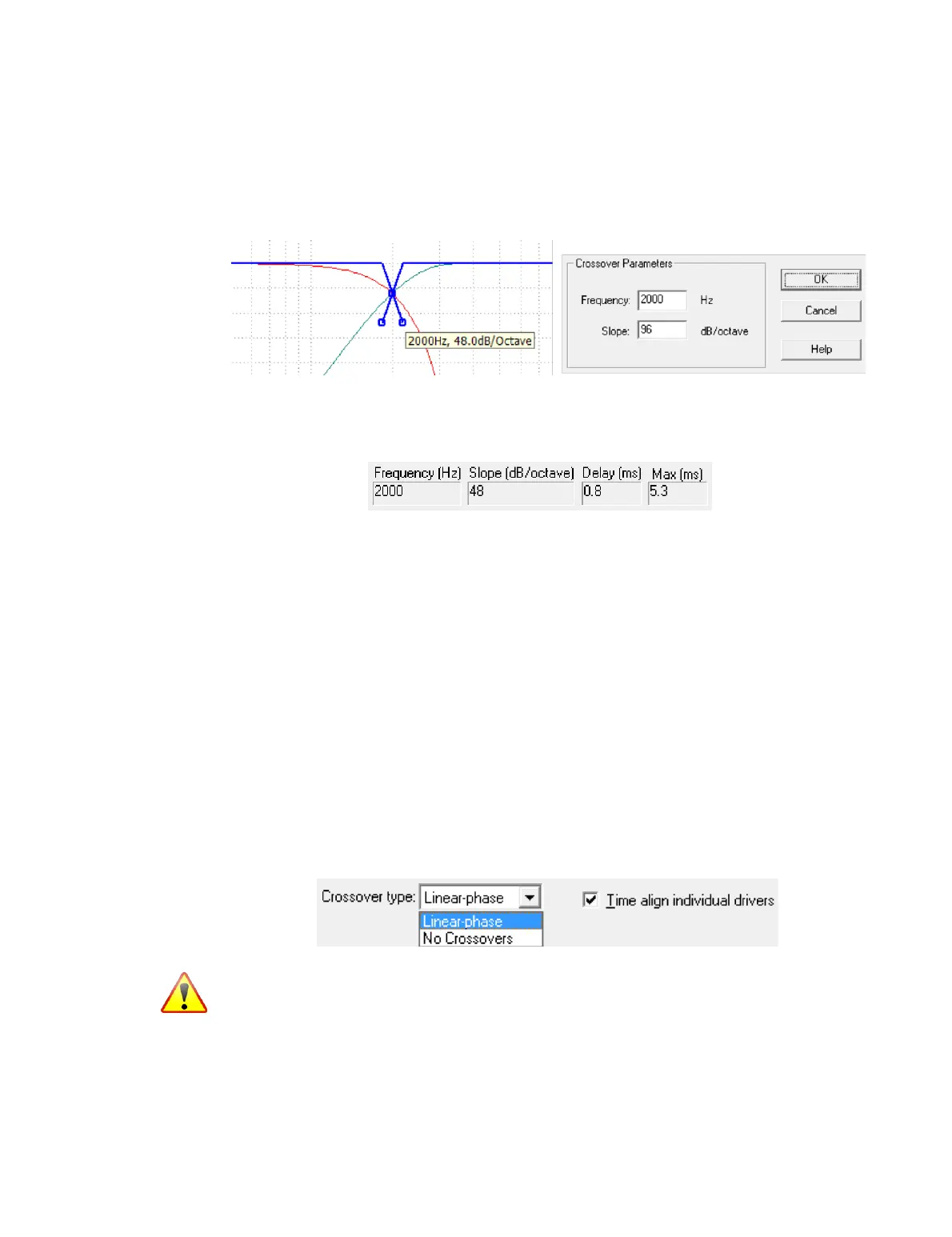
To change the crossover frequency, drag the central control point (below left). To
change the crossover slope, drag one of the two lower control points to the left or right.
Alternatively, double-click on the crossover control to bring up a dialog that allows you
to enter the frequency and slope directly (below right).
Hovering the mouse over a control point will display the crossover frequency and slope.
The frequency and slope are also displayed above the plot area, together with the delay
introduced by that choice of frequency and slope, and the maximum allowed delay.
(If you choose a combination of frequency and slope that exceeds the maximum
allowed delay, a dialog box will warn you.)
The choice of crossover frequency and slope is a trade-off between driver on-axis and
off-axis response, distortion, excursion limits, and other potential driver issues such as
resonance or ringing. DEQX recommends a slope between 48 and 96 dB/octave for
most speakers. Higher slopes can be auditioned by creating additional correction sets.
Slopes higher than 96 dB/octave (up to 300 dB/octave) may be important in cases such
as when drivers have pronounced resonance just outside the pass band, or in order to
sharply limit signal below the crossover frequency to tweeters and midrange units being
driven at high power (such as in sound reinforcement applications).
In the case of hybrid active-passive speakers, set the crossover to the same frequency as
the passive crossover, or near to it. This frequency will be visible in the plots as the
intersection of the measured responses.
Two additional controls are visible on this tab:
Crossover type
For an active speaker, this setting must always be set to “Linear-phase.”
For a hybrid active-passive speaker, this can be set to “No Crossovers,” in which
case both amplifiers will receive the same frequency range and the passive
crossover in the speaker will work to split the frequency range.



 To Next Page