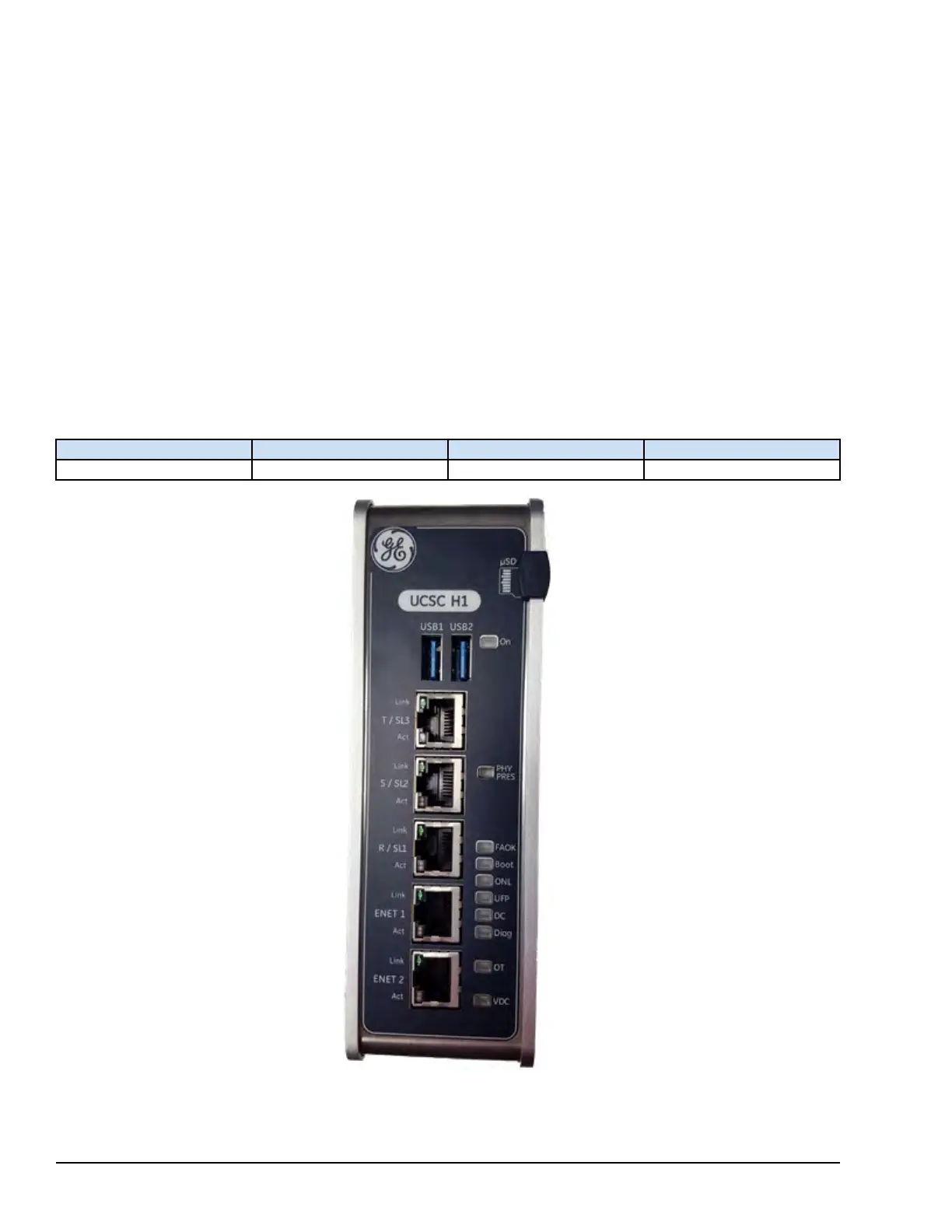
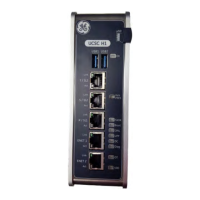
2.1.1 Mark VIe UCSCH1B Controllers
The Mark VIe IS420UCSCH1B quad core controller uses real-time hypervisor technology and QNX
®
Neutrino, a real-time,
multi-tasking operating system (OS) to run high-speed, high-reliability industrial applications. Embedded Field Agent (EFA)
technology is used to apply Predix™ cloud-based applications and/or locally hosted web applications over a secure
connection and deliver real-time data.
The UCSCH1x controller is loaded with software specific to its application. As a turbine or balance of plant (BoP) controller,
it runs the Mark VIe firmware and applications and utilizes IONet interfaces. IONet is a private special-purpose Ethernet that
only supports Mark controls I/O packs and controllers. IEEE 1588 protocol is used through the IONet interfaces to
synchronize the clock of the I/O modules and controllers to within ±100 microseconds. External data is transferred to and
from the control system database in the controller over the IONet interfaces. This includes process inputs/outputs to the I/O
modules. Unlike traditional controllers where I/O is on a backplane, the UCSC controller does not host any application I/O. In
a redundant set, all I/O networks are attached to each controller, providing them with all input data. This hardware and
software architecture guarantees that no single point of application input is lost if a controller is powered down for
maintenance or repair.
The UCSCH1B is available beginning with ControlST* V07.01, and supports Simplex, Dual, and Triple Modular Redundant
(TMR) redundancy.
UCSCH1 Platform Configuration Supported Features
Platform Embedded PPNG Embedded EtherCAT EFA
UCSCH1B X X
✓
Mark VIe UCSCH1B Controller
18 GEH-6855_Vol_II GEH-6855_Vol_II Mark VIeS Functional Safety Systems Volume II
Public Information


 To Next Page