5.4.4 TBCI Specifications
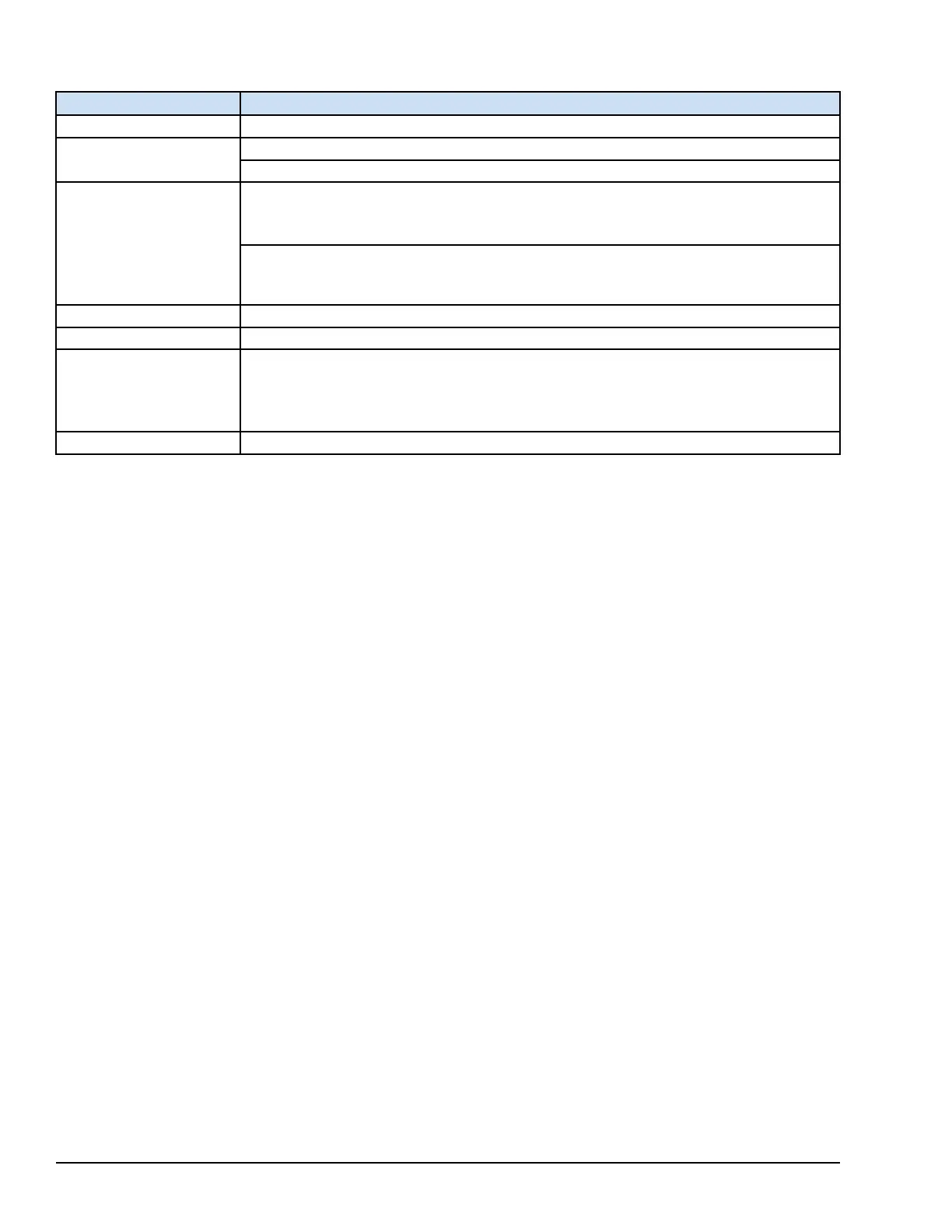
Item
TBCI Specification
Number of channels
24 contact voltage input channels
Excitation voltage
S2: Nominal 24 V dc, floating, 20 V dc min, 32 V dc max
S3: Nominal 48 V dc, floating, 43 V dc min, 53 V dc max
Input current
S2 (for 24 V dc applications):
First 21 circuits draw 2.5 mA (10 kΩ)
Last three circuits draw 9.9 mA (2.40 kΩ)
S3 (for 48 V dc applications):
First 21 circuits draw 2.5 mA
Last three circuits draw 10 mA
Input filter
Hardware filter, 4 ms
Power consumption
20.6 W on the terminal board
Fault detection
Loss of contact input excitation voltage
Non-responding contact input in test mode
Unplugged cable or loss of communication with I/O board: contact status is displayed as False
and Unhealthy.
Size
33.02 cm high x 10.16 cm wide (13.0 in x 4.0 in)
5.4.5 TBCI Diagnostics
Diagnostic tests to components on the terminal boards are as follows:
• The excitation voltage is monitored. If the excitation drops to below 40% of the nominal voltage, a diagnostic alarm is set
and latched by the I/O pack.
• YDIA I/O pack performs periodic self test of all contact inputs. In a alternative sequence each contact is forced open or
closed and reads the status, if any contact fails the test a fault is created.
• If the input from this board does not match the TMR voted value from all three boards, a fault is created.
• Each terminal board connector has its own ID device that is interrogated by the I/O pack. The connector ID is coded into
a read-only chip containing the board serial number, board type, revision number, and the JR1/JS1/JT1 connector
location. When the chip is read by the I/O pack and a mismatch is encountered with what is configured in the ToolboxST
application, a hardware incompatibility fault is created.
126 GEH-6855_Vol_II GEH-6855_Vol_II Mark VIeS Functional Safety Systems Volume II
Public Information


 To Next Page