6.6.3 TRLYS1D Operation
The six relays have a MOV and clamp diode for transient suppression between the NO and power return terminals. The relay
outputs have a fail-safe feature that votes to de-energize the corresponding relay when a cable is unplugged or communication
with the associated I/O pack is lost.
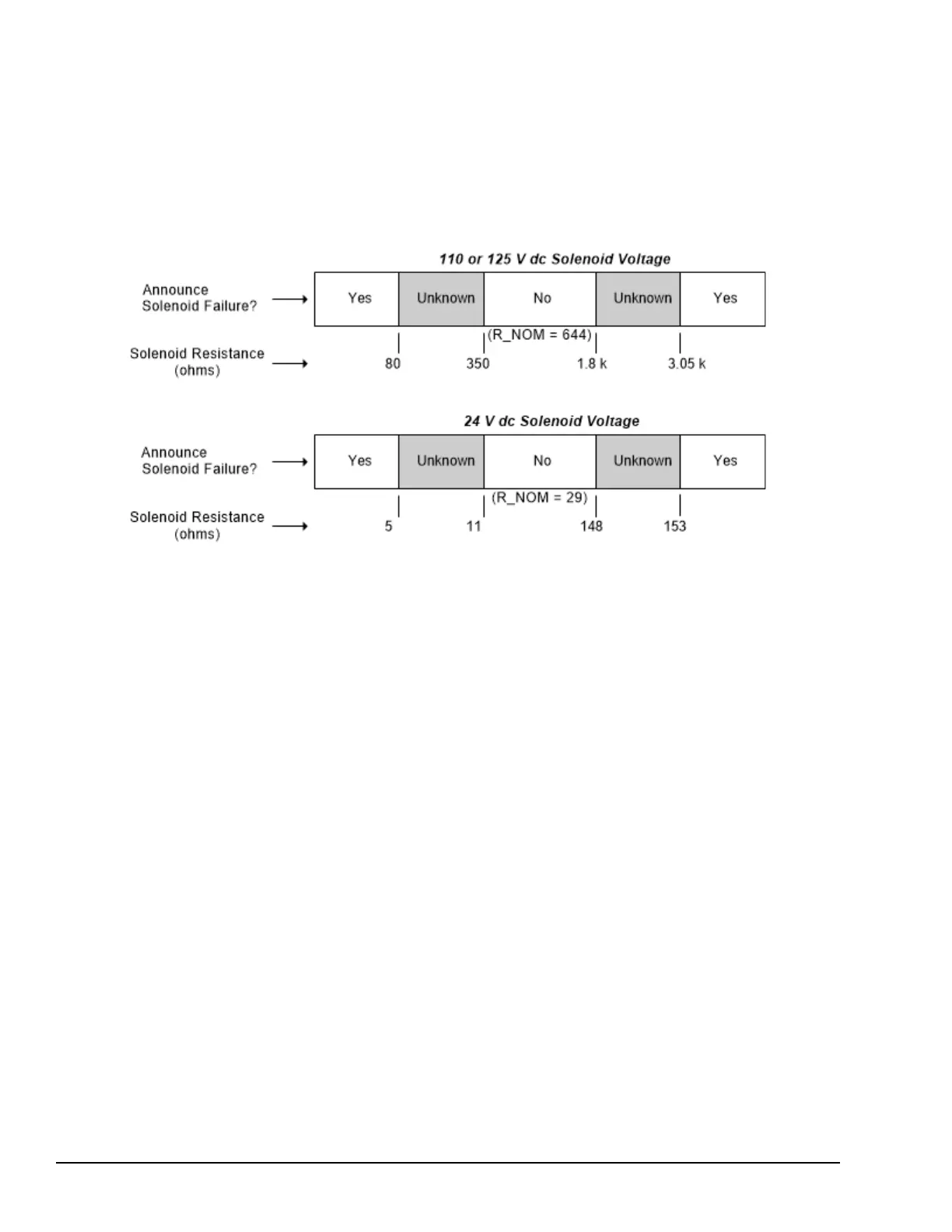
The TRLYS1D monitors each solenoid between the NO and SOL output terminals. When the relay is de-energized, the circuit
applies a bias of less than 8% nominal voltage to determine if the load impedance is within an allowable band. An alarm is
generated when the contact is open and the impedance is too low or too high for 20 consecutive scans (500 ms frame rate = 10
seconds). The contacts must be open for at least 1.3 seconds to get a valid reading.
TRLYS1D Solenoid Fault Announcement
For simplex operation, cables carry control signals and solenoid monitoring feedback voltages between the I/O pack and
TRLYS1D through JA1. For TMR applications, relay control signals are fanned into TRLYS1D from the three I/O packs R, S,
and T through plugs JR1, JS1, and JT1. These signals are voted and the result controls the corresponding relay driver. Power
for the relay coils comes in from all three I/O packs and is diode-shared.
152 GEH-6855_Vol_II GEH-6855_Vol_II Mark VIeS Functional Safety Systems Volume II
Public Information


 To Next Page