Keysight N9915-90020 User’s Guide 61
CAT (Cable and Antenna Test) Mode
2-Port Insertion Loss Measurements
10. Connect a LOAD at the end of the cable to be tested. This limits the
reflections to faults that are located in the cable under test.
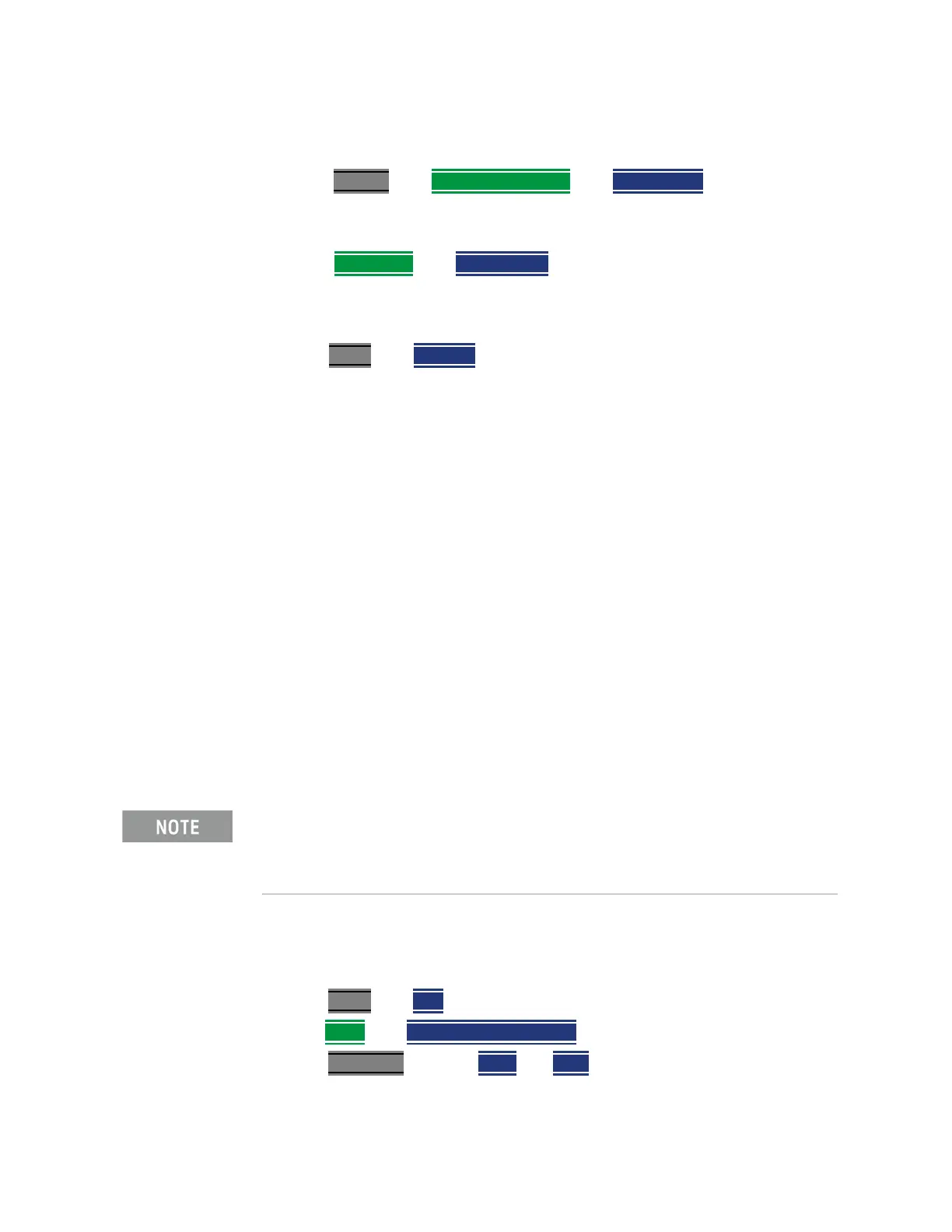
11. Press Trace 6 then Math and Memory then Data->Mem to store the trace
into Memory.
12. Remove the LOAD and leave the end of the cable to be tested open.
13. Press
Data Math then Data – Mem. The ripple in the measurement is
removed. These minor imperfections in the cable should not be considered
in the Cable Loss measurement.
14. Use Averaging to remove random noise from high-loss measurements.
Press BW 2 then Average.
The displayed trace shows the Cable Loss values in one direction through the
cable. A Return Loss measurement would show the loss for both down the
cable and back. Therefore, a Cable Loss measurement is the same as a Return
Loss measurement divided by 2.
The average Cable Loss across the specified frequency range is shown on the
screen below the graticules.
2-Port Insertion Loss Measurements
A 2-port Insertion Loss measurement is used to measure the loss through a
DUT (device under test) – or cable – over a specified frequency range. The
FieldFox signal source is transmitted out the RF OUT connector, through the
DUT, and into the RF IN connector. Both ends of the DUT must be connected
to the FieldFox, either directly or indirectly using the cable used in the
normalization cal.
‘Insertion’ loss simply means loss through a device, usually expressed in dB. It
is exactly the same measurement as “S21 Transmission” in NA Mode.
2-port Insertion Loss measurements are generally more accurate than 1-port
Cable Loss measurements.
How to make a 2-port Insertion Loss Measurement
—Press Mode then CAT.
—Then
More then Insertion Loss (2-Port).
—Press Freq/Dist
and enter Start and Stop frequency values of the
measurement.
Exception: In CAT mode, if the TDR data are saved in S1P format, the
values represent the real part of the complex transform; the imaginary part
is set to zero. To obtain complex data, either as real/imaginary or
magnitude/phase pairs, use NA mode.







 To Next Page