CONVENTIONAL BRAKE SYSTEM
P–19
P
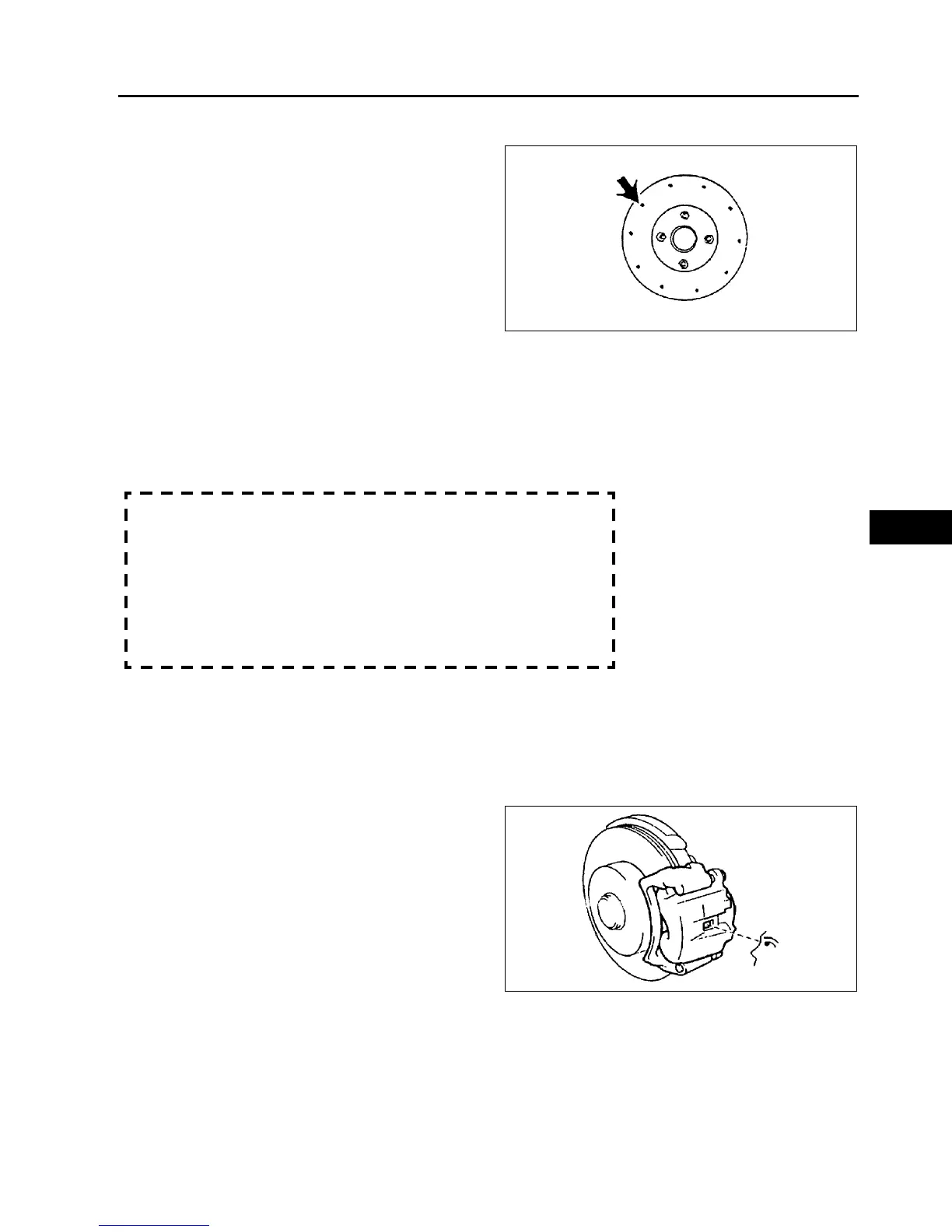
Thickness variation inspection
1. Clean the disc plate-to-pad friction surface using a brake cleaner.
2. Measure the points indicated in the illustration
using a caliper (micrometer).
3. Subtract the minimum value from the maximum,
and if the result is not within specification,
machine the disc plate using a lathe.
Thickness variation limit
0.015 mm {0.00059 in}
Warning
• Do not exceed minimum disc plate
thickness.
Disc Plate Thickness Inspection
Caution
• Excessive runout may result if the disc plate is removed from the vehicle then machined. Machine
the disc plate while installed on the vehicle.
1. Measure the thickness of the disc plate.
• If the thickness is not within the specification, replace the disc plate.
Minimum
L8, LF (GCC specs.):
22 mm {0.87 in}
LF (European (L.H.D. U.K.) specs.), L3:
23 mm {0.91 in}
Minimum thickness after machining using a brake lathe on-vehicle
L8, LF (GCC specs.):
22.8 mm {0.90 in}
LF (European (L.H.D. U.K.) specs.), L3:
23.8 mm {0.94 in}
Disc Pad Thickness Inspection
1. Jack up the front of the vehicle and support it with safety stands.
2. Remove the wheel and tires.
3. Verify the remaining thickness of the pads.
Minimum thickness
2.0 mm {0.079 in} min.
4. Replace the pads as a set: right and left wheels, if
either one is at or less than the minimum
thickness.
End Of Sie
X3U411WAR
X3U411WAS



 To Next Page