General Information
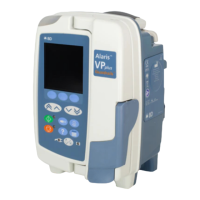
BD Alaris
TM
System with Guardrails
TM
Suite MX User Manual 275
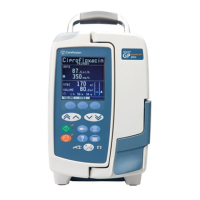
Model 8210
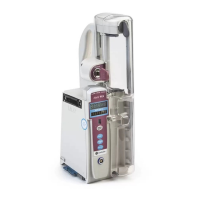
Model 8220
Feature Definition
SatSeconds™
SatSeconds™ limits controls time %SpO
2
level can fall outside the alarm limits before an
audible alarm sounds. Method of calculation is as follows:
Number of percentage points %SpO
2
falls outside of the alarm limit is multiplied by
number of seconds %SpO
2
level remains outside that limit.
Points x Seconds = SatSeconds™
Points = %SpO
2
percentage points outside of limit
Seconds = number of seconds %SpO
2
remains at that point outside of the limit
Saturation levels might fluctuate rather than remain steady for a period of several seconds.
%SpO
2
levels might fluctuate above and below alarm limit, reentering nonalarm range several
times. During such fluctuations, %SpO
2
module integrates number of %SpO
2
points, both
positive and negative, until either SatSeconds™ limit (SatSeconds™ time setting) is reached or
%SpO
2
level returns to within a normal range and remains there.
SatSeconds™ “Safety Net” is for patients with saturation levels h
aving frequent excursions
below limit but not staying below limit long enough for SatSeconds™ time setting to be reached.
When three or more limit violations occur within 60 seconds, an alarm sounds, even if
SatSeconds™ time setting has not been reached.
SatSeconds™
alarm management
With SatSeconds™ alarm management technology, upper and lower alarm limits are set in the
same way as with traditional alarm management. A SatSeconds™ limit can be set to allow
monitoring of %SpO
2
below selected low alarm limit for a period of time before an audible alarm
sounds.
Features Definition
Fast SAT
When Fast SAT is enabled and there is one data point that is significantly different from
a previous data point, averaging is disregarded and most recent data point is displayed.
For example, if readings were 97%, 96%, 95%, and 85%, displayed saturation level
would be 85%.
PI
Perfusion index (PI) is a scaled numeric value derived from magnitude of pulsations
displayed on plethysmographic (pleth) waveform. It is calculated as a percentage of
pulsatile signal to nonpulsatile signal. PI is used to find best perfused site for sensor
placement (larger the PI, stronger the perfusion). Operating range is 0.02 to 20. Desired
number is greater than 1 or as large as possible.
Saturation Averaging Time
Averaging time can be set to 2, 4, 8, 10, 12, 14, or 16 seconds.
Sensitivity Mode
Sensitivity mode, normal or maximum, of current monitoring configuration is displayed
in options mode. Normal setting is used for normal patient monitoring purposes.
Maximum setting is used for improved low perfusion performance.
SET Technology
Signal extraction technology (SET) uses adaptive filters to separate arterial signal from
nonarterial noise. SET
provides for accurate readings under extreme conditions (such as
low perfusion and motion).
Signal I.Q.™Feature
A visual indication of pulsation at sensor site. Vertical bar height indicates quality of
measured signal. Signal I.Q.™ feature is related to proper sensor application, adequate
arterial signal, and intensity of motion. Use Signal I.Q.™ feature to verify optimal
sensor placement.



 To Next Page