General Information
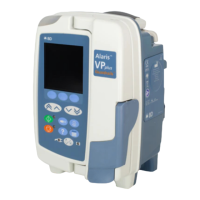
BD Alaris
TM
System with Guardrails
TM
Suite MX User Manual 281
NOTE:
Specification applies to monitor performance.
Adult specifications are shown
for OXIMAX
MAX-A and MAX-N sensors. Neonate specifications are
shown for O
XIMAX
MAX-N sensors. Saturation accuracy varies by sensor type.
Masimo
Board performance has been validated for low perfusion accuracy in bench–top testing against
a BIO-TEK simulator and a Masimo
simulator.
Masimo
Board performance has been validated for motion accuracy in human blood studies on healthy
adult volunteers in induced hypoxia studies, while performing rubbing and tapping motions at 2 - 4 Hz
at an amplitude of 1 - 2 cm and a nonrepetitive range of 70 - 100% SpO
2
against a laboratory
co-oximeter and ECG monitor. This variation equals plus or minus one standard deviation. Plus or
minus one standard deviation encompasses 68% of the population.
Masimo
Board performance with Masimo LNOP™ Neo and Neo Pt sensors has been validated for
neonatal motion accuracy in human blood studies on neonates, while moving the neonate’s foot at
2 - 4 Hz at an amplitude of 1 - 2 cm against a laboratory co–oximeter and ECG monitor. This variation
equals plus or minus one standard deviation. Plus or minus one standard deviation encompasses 68%
of the population.
Masimo
Board performance has been validated for no-motion accuracy in human blood studies on
healthy adult volunteers in induced hypoxia studies, in the range of 70 - 100% SpO
2
against a
laboratory co–oximeter and ECG monitor. This variation equals plus or minus one standard deviation.
Plus or minus one standard deviation encompasses 68% of the population.
Measurement Accuracy
If the accuracy of any measurement does not seem reasonable, first check the patient’s vital signs by
alternate means and then check the SpO
2
module to ensure that it is functioning properly.
NOTE:
Because the SpO
2
module's measurements are statistically distributed, only about two-thirds of the
SpO
2
module measurements can be expected to fall within ±Arms of the value measured by a co-oximeter.
An inaccurate measurement can be caused by:
• Incorrect sensor application or use.
• Significant levels of dysfunctional hemoglobins (such as carboxyhemo
globin or methemoglobin).
• Intravascular dyes (such as indocyanine green or methylene blue).
• Exposure to excessive illumination;
such
as, a surgical lamp (especially one with a xenon light source),
bilirubin lamp, fluorescent light, infrared heating lamp, or direct sunlight.
• Prolonged and/or excessive patient movement.
• Venous pulsations.
• Sensor placed on an extremity with a blood pressure cuf
f, arterial catheter, intravascular line or other
causes of insufficient perfusion.
• Nail irregularity, such as nail polish or fungus. Remove nail polish and
/or move sensor to an unaffected
site.
• Placement is too close to electrosurgery e
quipment.
• Defibrillation.



 To Next Page