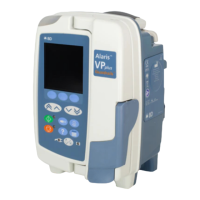
Chapter 3—BD Alaris™ Pump Module Model 8100, Alaris™ Pump Module Model 8100, and Alaris™
Syringe Module Model 8110
72 BD Alaris
TM
System with Guardrails
TM
Suite MX User Manual
For instructions on how to go from checking in a syringe module to preparing it for an infusion setup,
including how to change a syringe during infusion, see General Setup and Operation on pa
ge 165.
1. Prepare syringe (for a list of compatible syringes, refer to Compatible Syringes (Syringe Module) on
page 175) in accordance with manufacturer’s user manual.
2. Prepare administration set (for a list of compatible
Alaris syrin
ge module sets, refer to Alaris™
Syringe Module Set Compatibility Card) in accordance with manufacturer’s user manual.
3. Attach upper fitting of administration set to syringe tip.
NOTE:
For a list of compatible syringes, refer to Compatible Syringes (Syringe Module) on page 175. For a list
of compatible sets, refer to the Alaris™ Syringe Module Set
Compatibility Card.
• Use compatible components which have the smallest internal volume or “deadspace” to
minimize residual volumes between the syringe and the patient when administering
medications or fluids at low infusion rates (for example,< 5 mL/h, and especially flow rates
< 0.5 mL/h). This reduces the amount of time it takes for fluid to reach the patient, maintains
delivery accuracy, and reduces occlusion detection times.
• Ensure that the device is as close to level of patient’s heart as possible. Patient’s heart level
should be in line with the
CHANNEL SELECT key.
• Use the
PRIME SET WITH SYRINGE channel option on the syringe module to speed up the
engagement of the module’s mechanical components and decrease the syringe’s internal
friction (see Prime—Using Options Menu on page 79).
• If using a pre-run infusion practice (to allow for medication equilibration prior to connection to
the patient), ensure that the distal end of the administration set is level with or higher than the
device.
• Avoid use of manifolds with ports containing high pressure valves. High pressure valves
require additional pressure (for example, 50 - 200 mmHg) to open and allow fluid flow. These
high pressure valves may cause a significant delay in therapy followed by a sudden bolus
once the valve is opened, particularly at low infusion rates (for example, < 5 mL/h and
especially flow rates < 0.5 mL/h).
These recommendations are especially important when infusing high-risk or life-sustaining
medications at low infusion rates (for example, < 5 mL/h and especially at flow rates
< 0.5 mL/h).



 To Next Page