D.3
Date Code 20130214 Instruction Manual SEL-2414 Transformer Monitor
DNP3 Communications
DNP3 in the SEL-2414
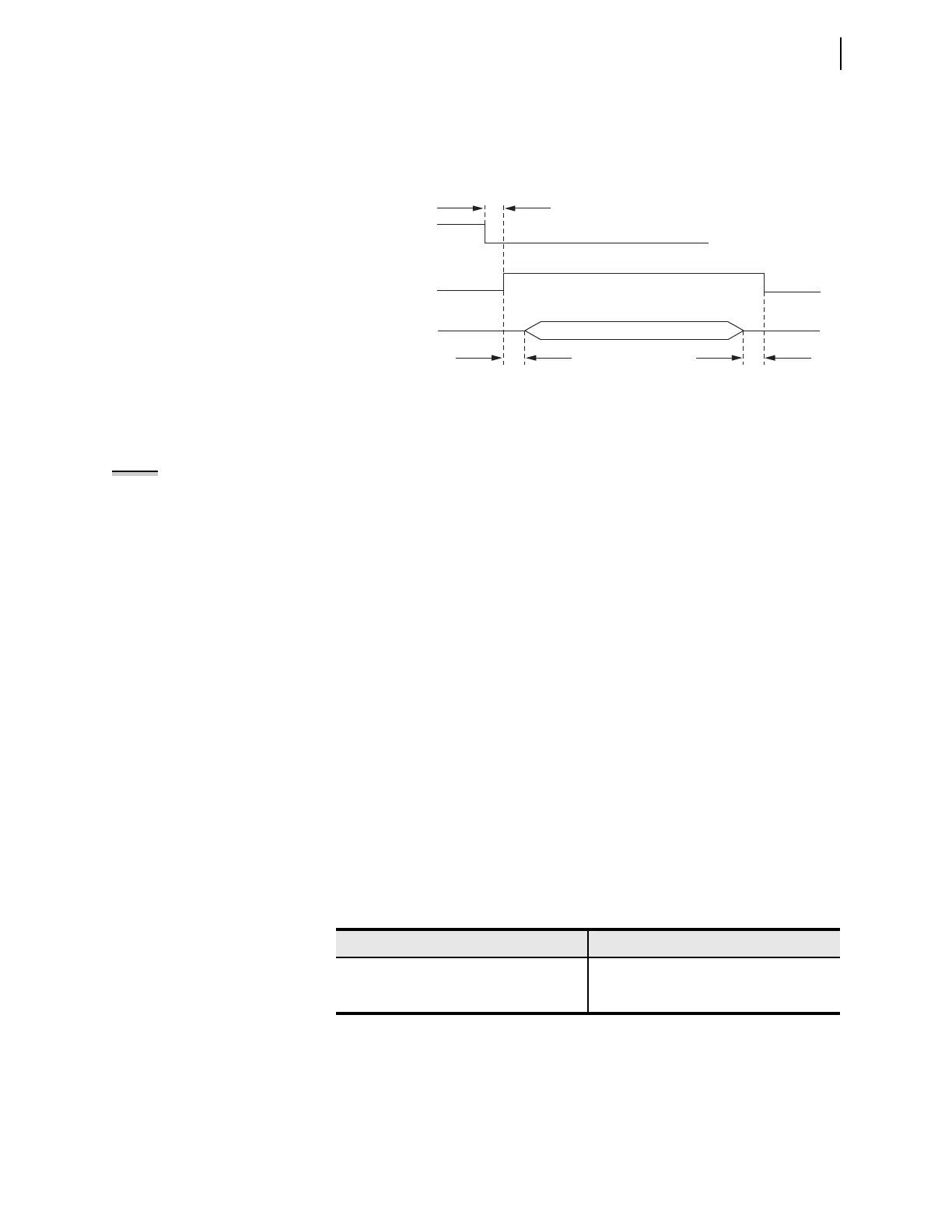
The Transformer Monitor pauses for a random delay between the settings MAX-
DLY and MINDLY when it detects a carrier through data on the receive line or
the CTS pin. For example, if you use settings of 0.05 and 0.10 s, the Transformer
Monitor will insert a random delay of 50 to 100 ms as shown in Figure D.2.
Transmission Control
If you use a media transceiver (for example, EIA-232 to EIA-485) or a radio sys-
tem for your DNP3 network, you may need to adjust data transmission proper-
ties. Use the PREDLY and POSTDLY settings to provide a delay between RTS
signal control and data transmission (see Figure D.2). For example, an EIA-485
transceiver typically requires 10 to 20 ms to change from receive to transmit. If
you set the pre-delay to 30 ms, you will avoid data loss resulting from data trans-
mission beginning at the same time as RTS signal assertion.
Event Data
DNP3 event data objects contain change-of-state and time-stamp information
that the Transformer Monitor collects and stores in a buffer. Points assigned in
the Binary Input Map that are also assigned in the Sequential Events Recorder
(SER) settings carry the time stamp of actual occurrence. Binary input points not
assigned in the SER settings will carry a time stamp based on the DNP map scan
time. This may be significantly delayed from when the original source changed
and should not be used for sequence-of-events determination. The DNP map is
scanned approximately once per second to generate events. You can configure the
Transformer Monitor to either report the data without a polling request from the
master (unsolicited data) or hold the data until the master requests it with an
event poll message.
The Transformer Monitor uses the NUMEVEn and AGEEVEn settings to decide
when to send unsolicited data to the master. The device sends an unsolicited
report when the total number of events accumulated in the event buffer for master
n reaches NUMEVEn. The device also sends an unsolicited report if the age of
the oldest event in the master n buffer exceeds AGEEVEn. The Transformer
Monitor has the buffer capacities listed in Table D.3.
Time Synchronization
By default, the Transformer Monitor accepts and ignores time set requests
(TIMERQn = I). (This mode allows the Transformer Monitor to use a high
accuracy, IRIG time source, but still interoperate with DNP3 masters that send
Figure D.2 Message Transmission Timing
Receipt of RX
DATA or CTS
Random Delay
MINDLY to MAXDLY
RTS
TX DATA
PREDLY PSTDLY
NOTE: PREDLY and POSTDLY
settings are only available for EIA-232
and EIA-485 serial port sessions.
Table D.3 Transformer Monitor Event Buffer Capacity
Type Maximum Number of Events
Binary 1024
Analog 100
Counters 32


 To Next Page