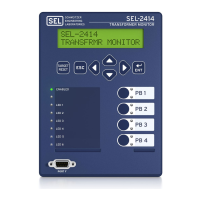
Date Code 20130214 Instruction Manual SEL-2414 Transformer Monitor
Appendix D
Instruction Manual
DNP3 Communications
Overview
The SEL-2414 Transformer Monitor provides a Distributed Network Protocol
Version 3.0 (DNP3) Level 2 Outstation interface for direct serial and LAN/WAN
network connections to the device.
The DNP Users Group maintains and publishes DNP3 standards. See the DNP
Users Group website, www.dnp.org, for more information on standards, imple-
menters, and tools for working with DNP3.
Objects
DNP3 object types, commonly referred to as objects, specifies the type of data
the object carries. An object can include a single value or more complex data.
If there can be more than one instance of an object type, then each instance has an
index that makes it unique. Each object also includes multiple versions called
variations. A master initiates all DNP3 message exchanges except unsolicited
data, with all points described from the perspective of the master.
Function Codes
Each DNP3 message includes a function code. Each object has a limited set of
function codes that a master may use to manipulate the object. The most common
DNP3 function codes are listed in Table D.1.
Qualifier Codes and
Ranges
DNP3 masters use qualifier codes and ranges to make requests for specific
objects by index. Qualifier codes specify the style of range, and the range speci-
fies the indices of the objects of interest. DNP3 masters use qualifier codes to
compose the shortest, most concise message possible when requesting points
from a DNP3 remote.
Table D.1 Selected DNP3 Function Codes
Function
Code
Function Description
1 Read Request data from the remote
2 Write Send data to the remote
3 Select First part of a select-before-operate operation
4 Operate Second part of a select-before-operate operation
5 Direct operate One-step operation with reply
6 Direct operate, no reply One-step operation with no reply


 To Next Page