5.7
Date Code 20130214 Instruction Manual SEL-2414 Transformer Monitor
Metering and Monitoring
Metering
Thermal Demand (EDEM := THM)
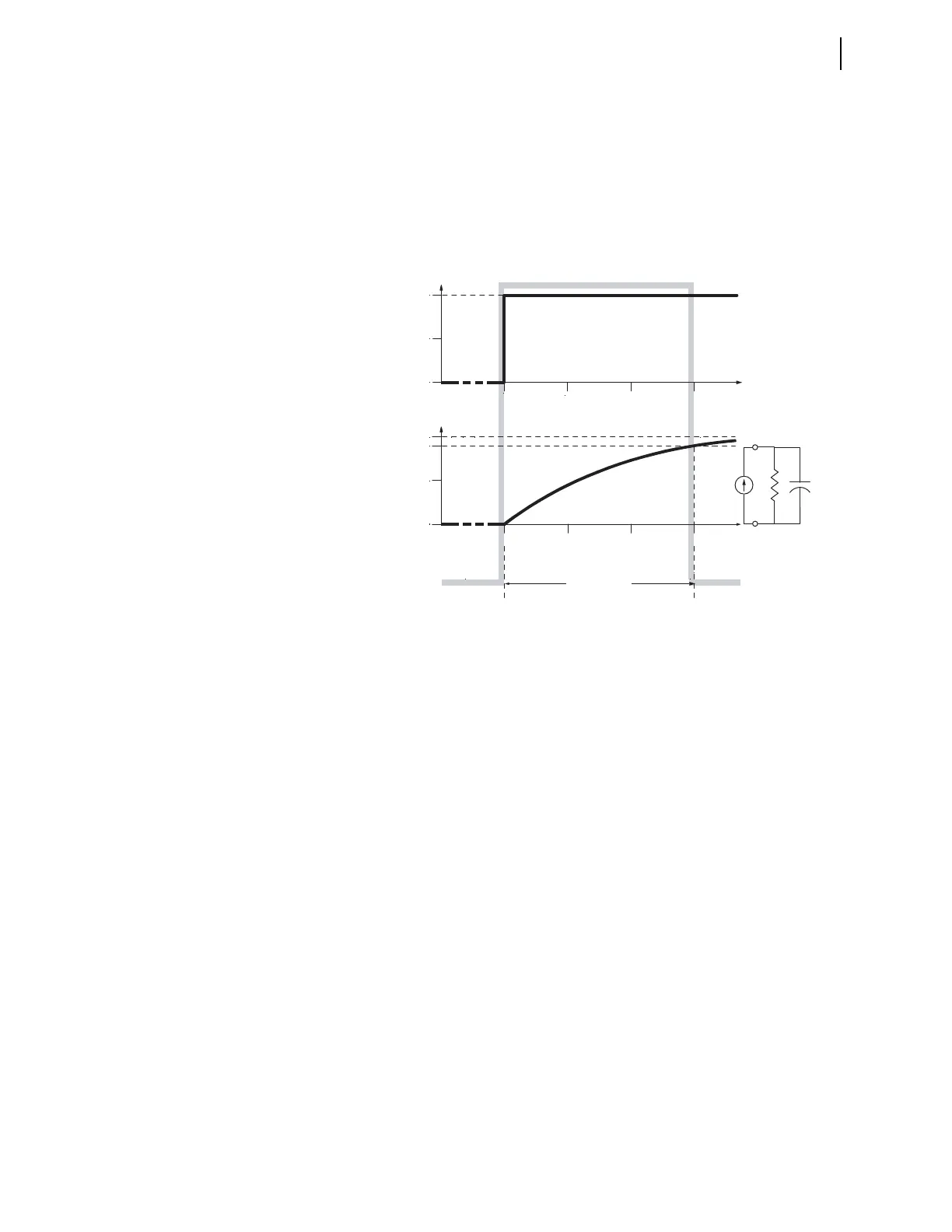
Thermal demand is a continuous exponentially increasing or decreasing
accumulation of metered quantities. Thermal demand measurement is similar to
parallel RC network integration. If current I
S
in Figure 5.5 has been at zero
(I
S
= 0.0 per unit) for some time, voltage VC across the capacitor is also at zero
(VC = 0.0 per unit). If current I
S
is suddenly stepped up to some constant value
(I
S
= 1.0 per unit), voltage VC across the capacitor starts to rise toward the
1.0 per-unit value.
Figure 5.5 Thermal Demand Metering
This voltage rise across the capacitor is analogous to the response of the thermal
demand meter to the step current input (top). In general, voltage VC across the
capacitor cannot change instantaneously but reacts as a function of the time
constant of the circuit. In the same manner, the thermal demand meter response is
not immediate either for the increasing or decreasing applied current, but in
accordance with the thermal time constant. For the thermal demand meter, the
time constant is the DMTC setting.
Thermal demand metering response is at 90 percent (0.9 per unit) of the full-
applied value (1.0 per unit) after a period equal to the DMTC setting (15 minutes
in Figure 5.5).
Rolling Demand (EDEM := ROL)
Rolling demand is a sliding time-window arithmetic average. Figure 5.6 shows
the rolling demand response for a step input for a demand meter time constant of
15 minutes (DMTC := 15). The device divides the DMTC period into three
5-minute intervals and averages the three DMTC sub-interval samples every
DMTC period.
Rolling demand metering response is at 100 percent (1.0 per unit) of the full
applied value after a time equal to the fourth DMTC period (see (d) in
Figure 5.6).
Step
Current
Input
Thermal
Demand
Meter
Response
(EDEM := THM)
1.0
1.0
0.9
0.5
0
0.5
0
0
5
10
15
0
510
15
Time
(minutes)
DMTC Period
Time
(minutes)
R
C
—
+
I
S


 To Next Page