1-4 Instrument description
sample list is used to create a series of sample entries, each of which contains
an instrument acquisition method and a GC method. When a sample is run,
the instrument acquisition starts when the GC oven sends a start signal to the
mass spectrometer acquisition controller, which is usually triggered by an
autosampler injecting.
See The MassLynx User’s Guide and MassLynx online Help.
Probe sample introduction
Probe sample introduction is a manual method, requiring that you load and
introduce the sample by hand. The usual sequence of events is that the
instrument is first set to acquire the data using the required scanning
technique and then the sample is introduced. The instrument can be set to
acquire using the MassLynx sample list or through the Tune window. It is
also possible to ramp the probe temperature by using the probe ramping
utility.
Vacuum system
The instrument’s vacuum system consists of fine pumping and fore pumping
systems. Before the fine pumping can be operated, you must fore pump the
region. Fore pumping can achieve a vacuum level of approximately 10
-2
mbar
inside the instrument. Fine pumping can achieve vacuum levels in the region
of 10
-8
mbar, which is necessary for the ultimate performance of the mass
spectrometer.
Fore pumping is manually controlled by miniature circuit breakers on the a.c.
distribution panel and switches on the vacuum pumps.
The fine pumps are controlled via the MassLynx software and miniature
circuit breakers on the a.c. distribution panel.
See “MassLynx control system” on page 1-5, “A.C. distribution panel” on
page 1-6, and “Controlling and monitoring the vacuum pumps” on page D-5.
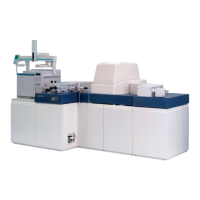
There are three main pumping regions in the AutoSpec Premier:
• The source
• The analyzer
• The gas inlets, valves, and interface areas



 To Next Page