354
each has its own complex combination of frequency components, which can change
across the duration of the sound.
The center line of a waveform is the zero line; it corresponds to the rest position
(displacement of 0) of the original vibrating object. (A waveform for perfect silence
would be a horizontal line at zero.) Back and forth motions of the vibrating object
translate to upward (positive) and downward (negative) excursions of waveform
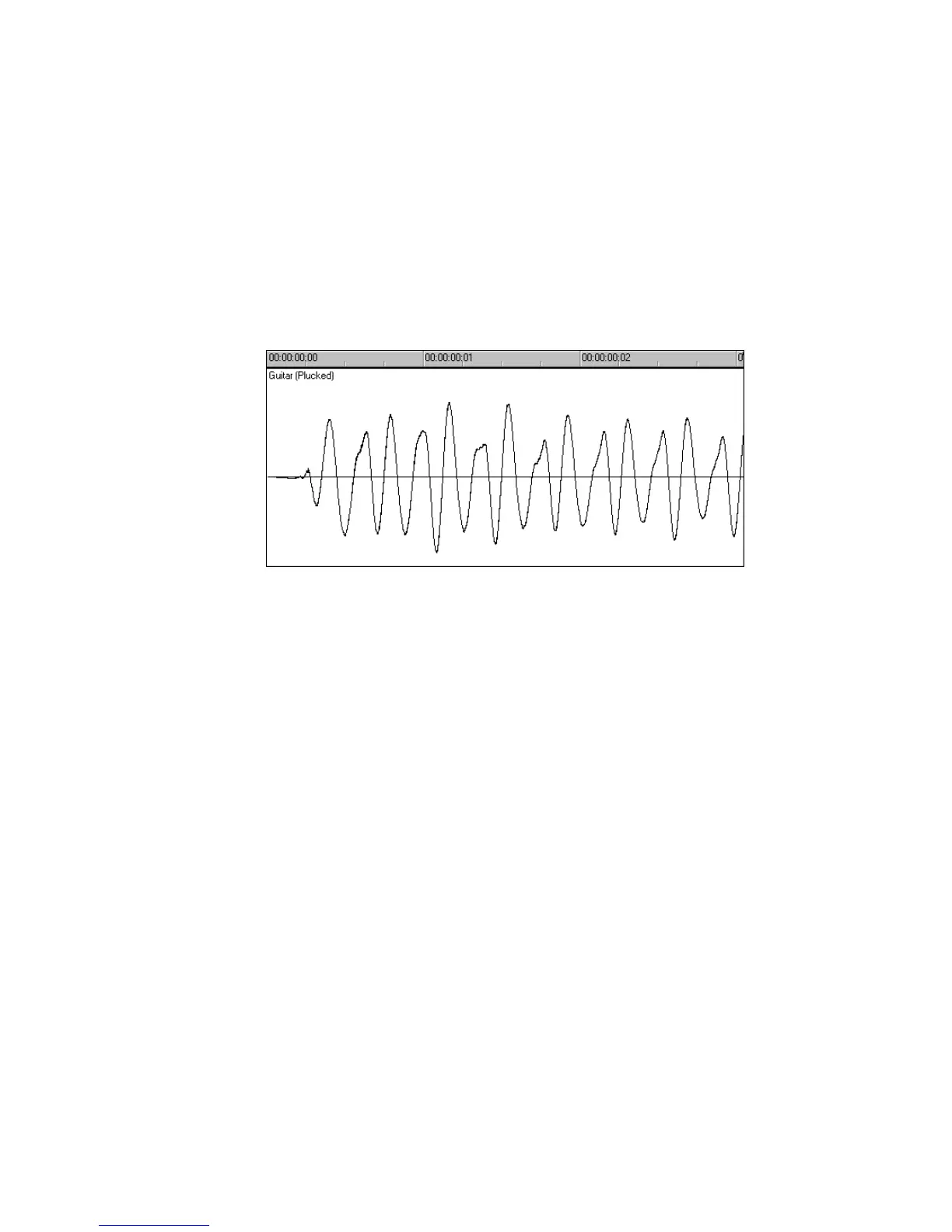
amplitude. For example, a close-up of a portion of the guitar waveform might look
like this:
The waveform crosses the zero line twice during each complete vibration. These
zero-crossings are important in digital audio processing; they are good places to
cut waveforms apart and splice them together. If waveforms are cut or spliced at
other locations, clicks and pops can occur. The maximum amplitude of the
waveform in each vibration is also important: it determines the strength of the
vibration, and thus the loudness of the sound.
Recording a Sound
To record digital audio, your computer monitors the electrical signal generated by
a microphone (or some other electroacoustical device). Because the signal is caused
by a sound, the signal strength varies in direct proportion to the sound’s waveform.
The computer measures and saves the strength of the electrical signal from the
microphone, thus recording the waveform.
There are two important aspects of this measuring process. First is the sampling
rate, the rate at which the computer saves measurements of the signal strength. It
is a known fact of physics that you must measure, or sample, the signal at a rate
at least twice that of the highest frequency you wish to capture. For example,
suppose you want to record a moderately high note on a violin—say the A whose
fundamental frequency is 440 Hz and all overtones up to five times the
fundamental. The highest frequency you want to capture is 2,200 Hz, so you need
to measure the electrical signal from the microphone at least 4,400 times per
second.



 To Next Page