355
Since humans can hear frequencies well above 10 kHz, most sound cards and
digital recording systems are capable of sampling at much higher rates than that.
Typical sampling rates used by modern musicians and audio engineers are 22 kHz,
44.1 kHz, and 48 kHz. The 44.1 kHz rate is called CD-quality, since it is the rate
used by audio compact discs.
The other important aspect of the measuring process is the sampling resolution.
The sampling resolution determines how accurately the amplitude of each sample
is measured. At present, the music industry has settled on a system that provides
65,536 different values to assign to the amplitude of a waveform at any given
instant. Thus, each sample saved by your computer requires 2 bytes (16 bits) to
store, since it takes 2 bytes to store a number from –32,768 to 32,767. The scaling
of the electrical input signal level to amplitude value is determined by your audio
hardware and by the position of your input level control.
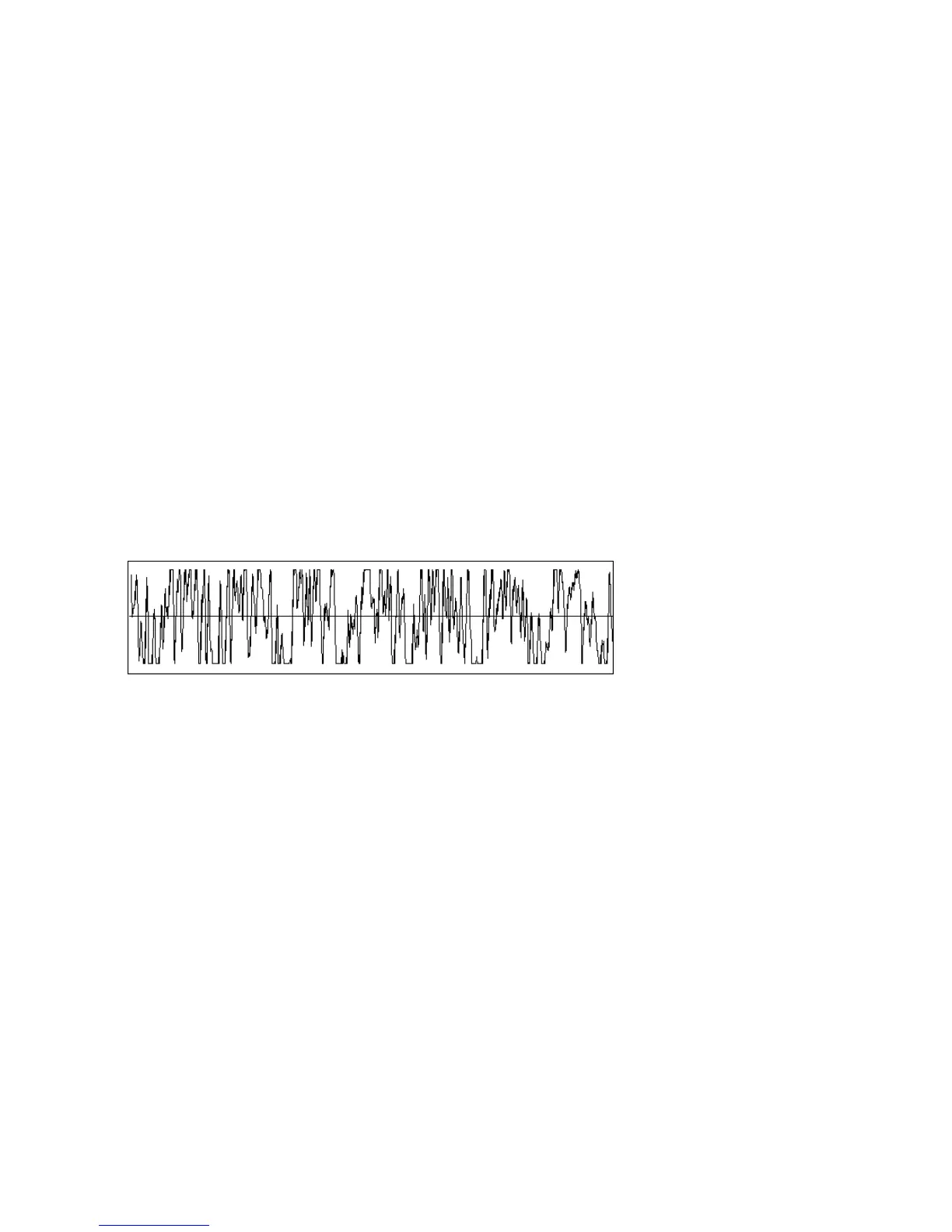
What if the amplitude of the sampled signal gets too high, such that a 16-bit
number is not large enough to represent it? What typically happens is that the
signal is clipped, cut off at the maximum value.
Here is what a clipped waveform might look like:
Clipping is not usually desirable and may have unpleasant audible effects. Sudden
irregularities in the waveform of any type can cause clicks, pops, and distortion of
the original sound.
The Decibel Scale
In acoustics, the decibel (dB) scale is a scale for measuring the relative loudness of
two sounds. For example, environmental noise is often measured as follows:
L = 20 log (p/p0)
where L is the sound pressure level (in dB), p is the sound pressure amplitude, and
p0 is a reference amplitude of 20 micropascals (less than one billionth of
atmospheric pressure). On this scale, a barely audible sound (p = p0) has a sound
pressure level of 0 dB, normal conversation (p = 1,000*p0) is at a level of around 60
dB, and a jet engine at close range (p = 1,000,000*p0) is at a level of around 120
dB.
Similar decibel scales are used in other branches of science and engineering to
measure electrical power levels and other signal levels, always with respect to
some reference level.



 To Next Page