59
MIDI is dedicated to percussion. The note determines the instrument, and the
patch is irrelevant.
Changing the Patch in the Track/Bus Inspector
You can also change a track’s patch in the Track/Bus Inspector, which is a
vertically expanded version of the current track’s controls at the far left side of the
Track view. The current track is the one with the gold title bar. Whichever track’s
controls that you click becomes the current track. For example, to change the
Piano track’s patch, click the Patch button in the Piano track’s Track/Bus
Inspector and choose a new patch from the menu. The Patch button is just below
the Bank button. You can hide or show the Track/Bus Inspector by pressing i on
your computer keyboard.
Playing Music on a Keyboard
If you've connected a MIDI keyboard (or another instrument) to your external
MIDI interface or the MIDI interface of your sound card, you can play one or more
parts of the project on the keyboard instead of the sound card’s internal
synthesizer. For instructions on connecting a keyboard to your computer, see “To
Connect a MIDI Keyboard to Your Computer” on page 26. For this section, we
assume that you want to connect the keyboard to the MIDI In and MIDI Out of
your sound card.
Checking Your MIDI Device Settings
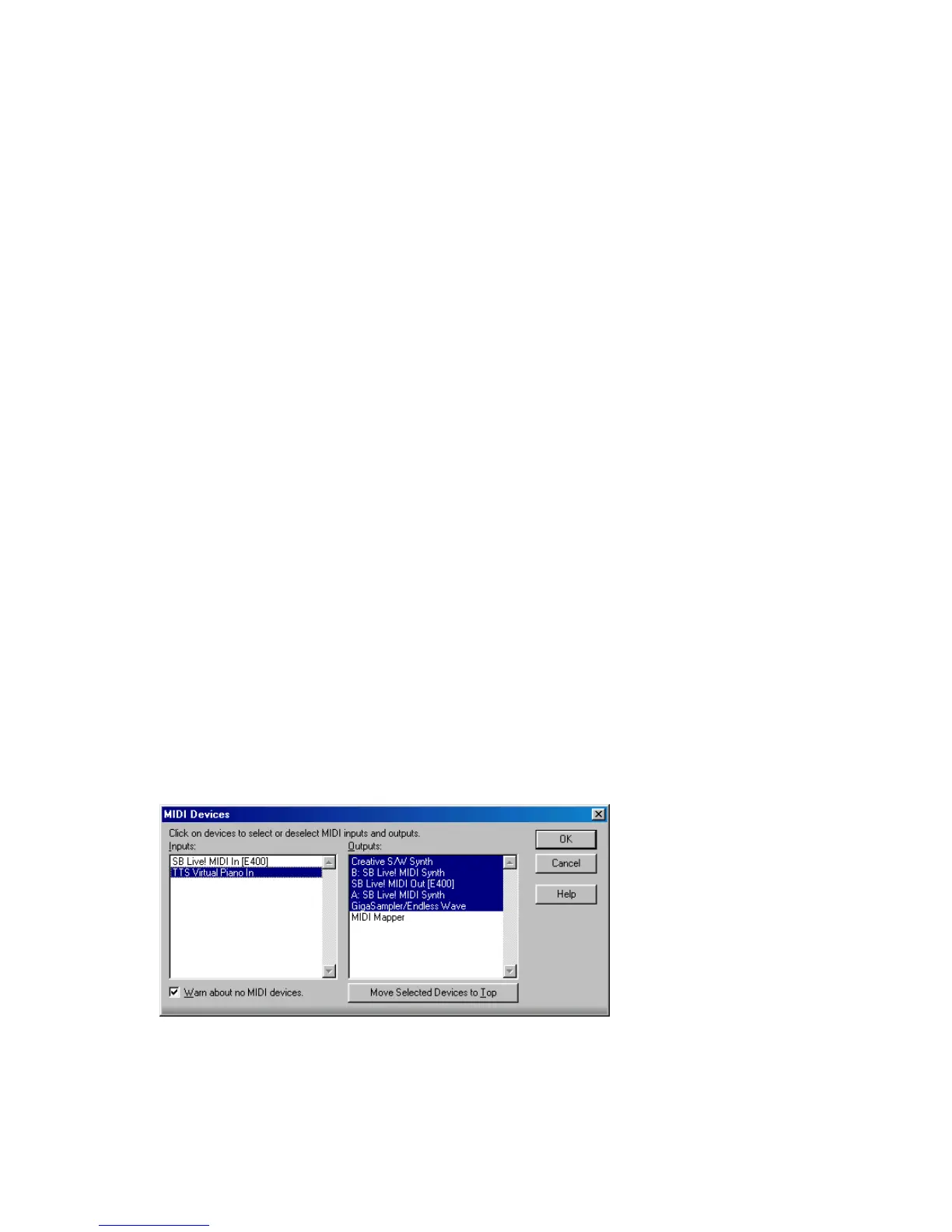
First, let’s make sure that SONAR is set up to send MIDI output to your keyboard.
1. Choose Options-MIDI Devices to open the MIDI Devices dialog box.
2. In the Outputs field, two devices should be selected. The first should be your
sound card synthesizer device; the second should be the MIDI output your
MIDI device is connected to (it should say something like “SB Live MIDI
Out”). The uppermost selected device will correspond to Output 1, the second
device to Output 2, and so on. For help with these settings, see “Setting Up
Output Devices” on page 134.
3. Click OK.



 To Next Page