TOS93 Series User’s Manual 63
Withstanding Voltage and Insulation Resistance Tests | Setting Test Conditions
Auto setting of the judgment delay (Delay Auto)
This can be set only in DC withstanding voltage (DCW) and insulation resistance (IR) tests.
When the test voltage is applied to an EUT
with a capacitive component, a large charge current may flow
until charging is completed. Judgment errors due to the effects of the charge current can be prevented by
setting a delay (Judge Delay) from when the START switch is pressed to when upper limit judgment is
started.
Set Delay Auto
to on or off to select auto or manual setting of the judgment delay.
Value Description
ON Upper limit judgment will start automatically when the voltage reaches the test voltage and
judgment becomes possible. If the output voltage is 200 V or more and the voltage rise rate is
less than approximately 1 V/s before the judgment starts, UPPER FAIL
1
occurs, and the test
ends. Problems can be discovered quickly such as when the EUT is shorted.
1 In an IR test, if Judge Type is set to Ω, LOWER FAIL will occur.
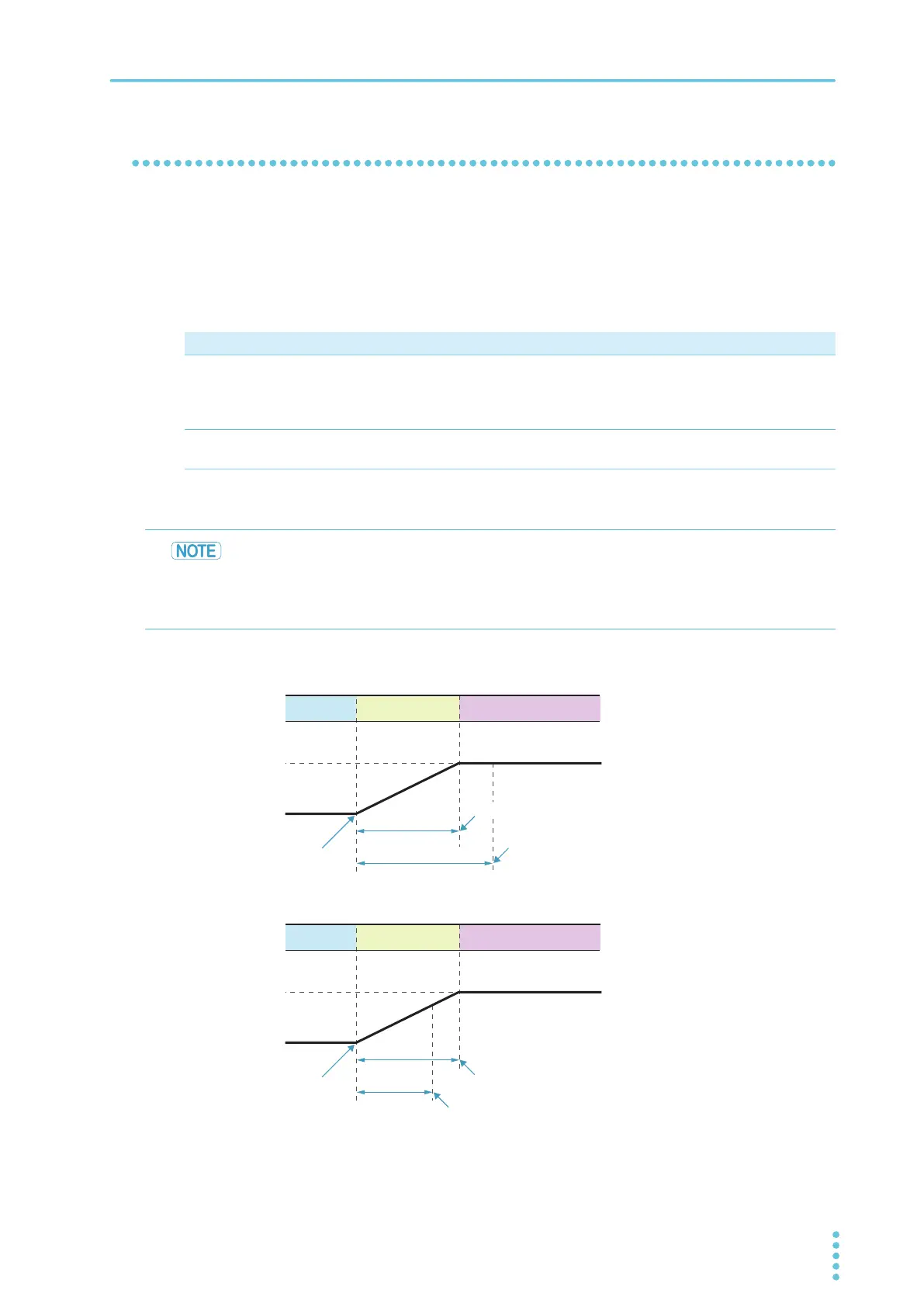
OFF Set the judgment delay (Judge Delay) manually. Refer to the following, and set a delay shorter
than the sum of Voltage rise time (p.66) and Test time (p.65).
In a insulation resistance (IR) test, consider the following:
• Making judgments on 200 μA or less requires at least 3 seconds after the rise time ends.
• Making judgments when the low pass filter (p.75) is set to on requires at least 10 seconds
after the rise time ends.
TESTRISE
READY
Rise Time
Lower judgment begins.
Upper judgment begins.
Press START.
Ŷ
When Judge Delay is longer than Rise Time
Output off
Test Voltage
Judge Delay
TESTRISE
READY
Rise Time
Lower judgment begins.
Upper judgment begins.
Press START.
Ŷ
When Judge Delay is shorter than Rise Time



 To Next Page