323
7. The alarm panel should recognise the wireless relay and confirm this with a long
signal. If not, repeat step 5.
8. Set SW1 of the wireless relay back to OFF. The LED of the wireless relay should
flash every second.
Please note:
The wireless relay can be used with a 9V or 12V DC mains adapter
None of the menus of the XT alarm panel lists the wireless relay; it is not even a
sensor, as it cannot trigger an alarm. You can verify the successful integration in
the following way: If the wireless relay clicks when the alarm panel is armed (SW
3 + 4 off), the relay is connected.
Please note that the wireless relay acts like an external siren. If the siren is
deactivated, then the wireless relay is too (see chapter “Alarm system“ “Siren
settings” “Alarm settings”)!
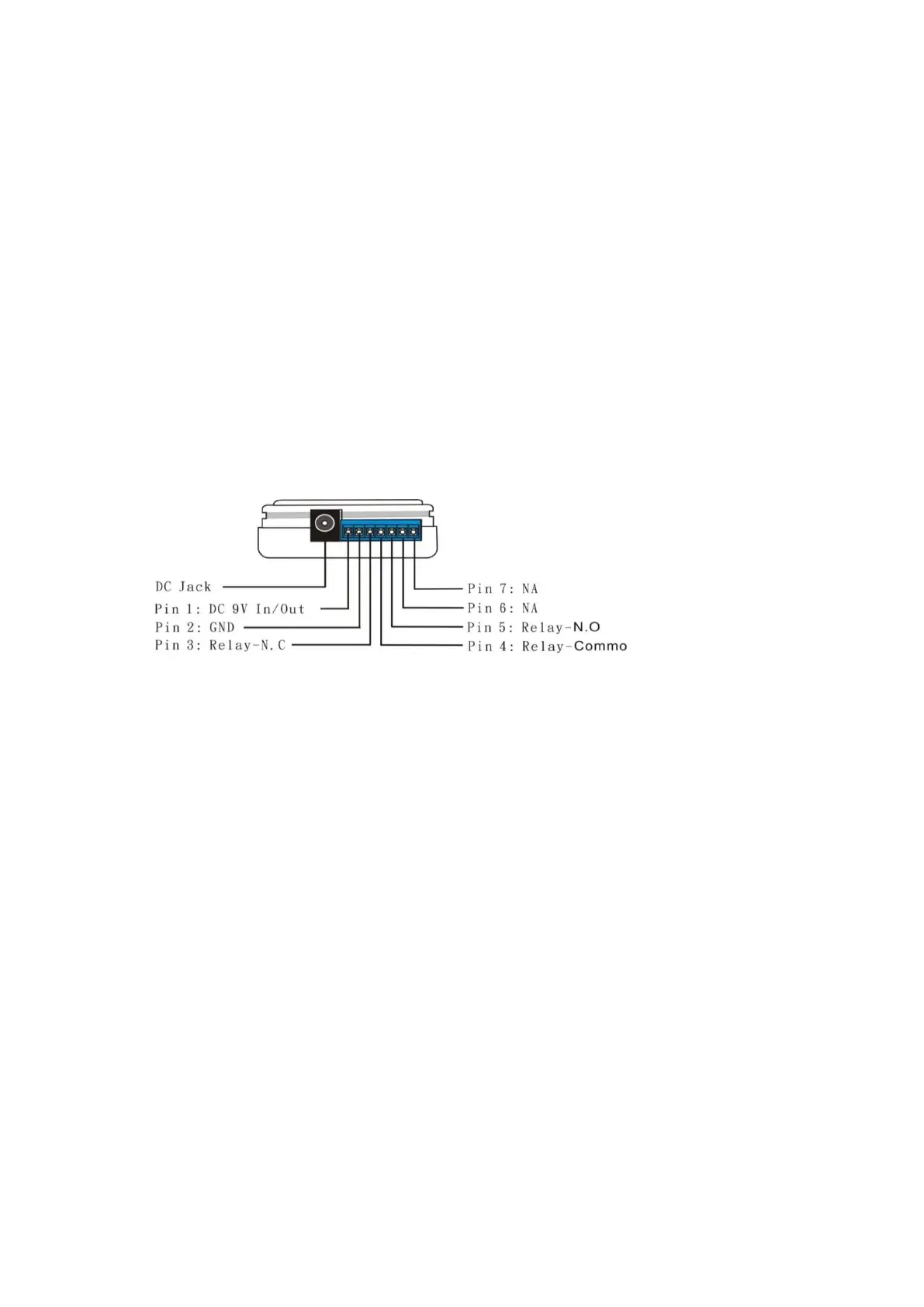
Seven terminals clamps are located on the bottom of the relay. The following figure
shows their function:
Pin 1 + 2 supply a constant 9 V DC output current. Pin 1 is the plus pole, pin 2 the
minus pole.
Pin 3: Normally closed (NC))
Pin 4: Common (C)
Pin 5: Normally open (NO)
Examples:
If you want to activate a device in case of alarm (depending on switch state 3+4) with 9
V power, it must be connected to pin 2 (GND) and pin 5 (NO). If you want to use only
the dry contact in case of alarm (relay circuit), connect the device to pin 4(C) + 5 (NO).
If you want to always use 9 V output voltage, except for a relay circuit, use pin 2 (GND)
and pin 3 (NC). If you want to always use a dry contact except in case of alarm (relay
circuit), connect pin 3 (NC) + 4 (C).
If you remove the 9 V jumper, only the dry contact can be used or the constant output
voltage can be tapped from pin 1 + 2. The combination of pin 2 and 5 or 2 and 3 is not
possible anymore.
Output capacitance:
The relay has a contact capacitance from 1 A 30V DC to 1 A 120V AC
Maximally 300 mA are available for the 9 VDC output.
The quiescent current is 0,432 watt.



 To Next Page