Chapter 3 Spectrum Analysis Operation
Setting up the trace
9102 Handheld Spectrum Analyzer Software version 5.31
71
Defining the number of
measurements for
averaging
When the trace mode is set to averaging, it may be useful to adjust the
number of measurements over which the 9102 averages the results.
The average count value that can be defined in the Trace menus
applies to both traces alike.
The 9102 uses a recursive algorithm in which a new result is added to
the older averages with a weighting factor; the description below indi-
cates how to change this weighting factor.
1 Enter the Trace menu (select
Trace > Trace A or Trace B from the
main menu).
2 Push the
Average Count softkey.
The Average input field opens.
3 Enter the number of measurements over which to average the
results, in the range from 2 to 128.
4Press E
NTER.
Selecting the detection
method
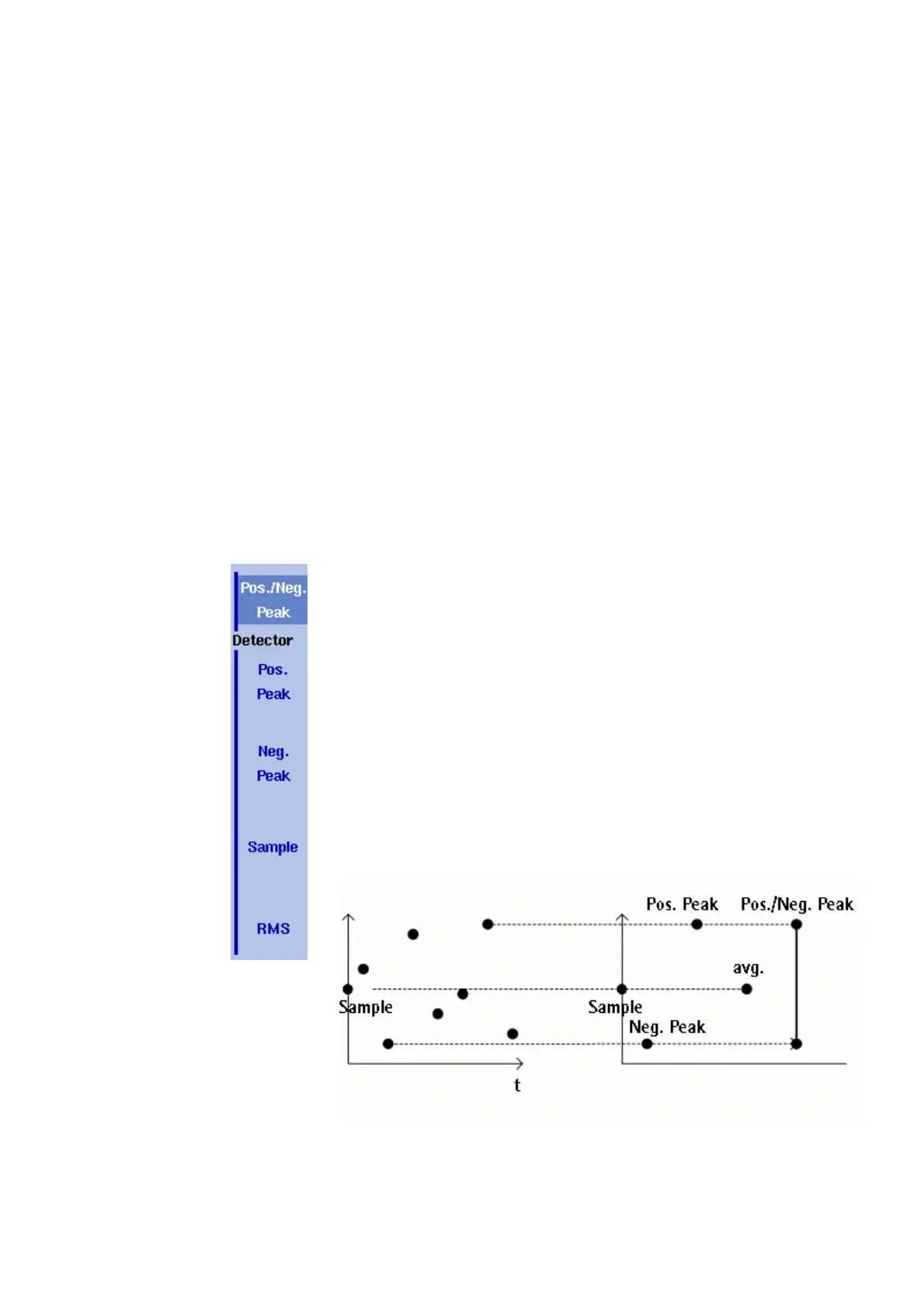
For each new measurement, the 9102 selects one or two values from
a number of measurements for each frequency value. The method is
user-definable; the following methods are available (see also
Figure 20):
– Positive/negative peak: Both the largest and smallest values are
taken and displayed as a vertical bar.
– Positive peak: Only the largest value is displayed.
– Negative peak: The smallest value is shown.
– Sample: A sample measurement value is picked.
– If the 9132 RMS Detector Option is installed and activated on your
9102, the root mean square detector showing the RMS-effective
level of the measured signal is also available. If the 9132 RMS
Detector Option is not installed on your instrument, the RMS
detector will be greyed out.
Figure 20 Trace detectors



 To Next Page