OPERATOR’S MANUAL
CMA-9000 FLIGHT MANAGEMENT SYSTEM
COMPONENT DESCRIPTION
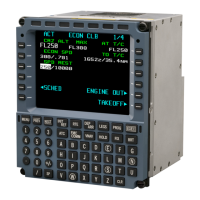
A. Flight Management System (FMS) with Embedded Display Unit
The CMA-9000 provides a color display of alphanumeric data. An alphanumeric keyboard allows data
entry, data editing and system control of the flight management functions.
The display is a sunlight readable color Active Matrix Liquid Crystal Display (AMLCD). Dedicated function
keys and line select keys allow easy operator control of flight management functions. The keyboard panel is
integrally lit from a panel light dimming bus. The front panel is illustrated in Section 2 along with an
explanation of the keys and their function.
For the control of the display brightness, two options are proposed. The first option consists in the
combination of light sensors and manual brightness setting. Two light sensors on the FMS front panel sense
any change in the cockpit ambient light level. This results in an increase or decrease in display brightness
relative to a manual brightness setting. The second option consists in an external dimming bus.
The Flight Management Unit (FMU) accepts data from external navigation sensors and performs all the
signal processing and computations required to generate high performance navigation data. The FMU
accepts operator’s commands from the alphanumeric keyboard, provides navigation, steering and status
data on its own display and to the primary navigation flight displays. The FMU also provides suitably
formatted outputs for the flight guidance system.
B. External Global Positioning System (GPS) Receiver
The external GPS Receiver receives signals transmitted by US DoD Global Positioning System satellites. It
provides all the signal processing and computational capability required to determine aircraft position,
velocity and time. The sensor continuously monitors the integrity of the satellites using a high performance
Receiver Autonomous Integrity Monitor (RAIM).
Page 1-2
August 17, 2010


 To Next Page