4535 612 10261 HD11 Service Manual Page 62
CSIP Level 1 Theory of Operation: Functional Description
review (PC). These executables communicate with each other over a high-speed serial link by
using a proprietary token ring network.
Functional
Description
Figure 4-1 is a simplified block diagram, showing the relationship of the electrical components
that make up the HD11 system, indicating the primary functional tasks performed by each.
The location and identification of the physical parts of the system are described in the General
Information, Cabling, Configuration, and Parts sections of this document. The functional nature
of each is described in the following sections.
After operating power is applied, the electronics and software combine to support the produc-
tion of ultrasound images. The user interface allows system control and viewing of the results.
The HD11 system produces 2D, M-mode, color Doppler, Color Power Angio imaging, Doppler,
3D, and, if equipped with the supporting hardware, 4D ultrasound images through the use of
transducers, digital beam forming, and Doppler processing.
The system stores the ultrasound images and patient data on the hard disk drive and can copy
that data to the removable media (CD-R/W and optional magneto-optical disks) for offline
review. The system can send these images to a black-and-white printer, to a color printer, or to
a VCR. It also generates printable reports.
Physical
Functions
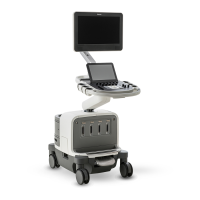
The HD11 physical structure is made of fabricated sheet metal and molded plastic parts. The sys-
tem consists of a cart, a user interface (control panel), a visual display (video monitor), and the
ultrasound electronic components. The major ultrasound components are the transducers, the
PC, the E-box, and the system power supply. For more information about the physical elements
of the system see “Physical Description” on page 37.



 To Next Page