Vista Digital Mixing System
3-32 Parameters SW V3.3 Date printed: 05.08.03
3.4.3.3 VSP Panning Parameters
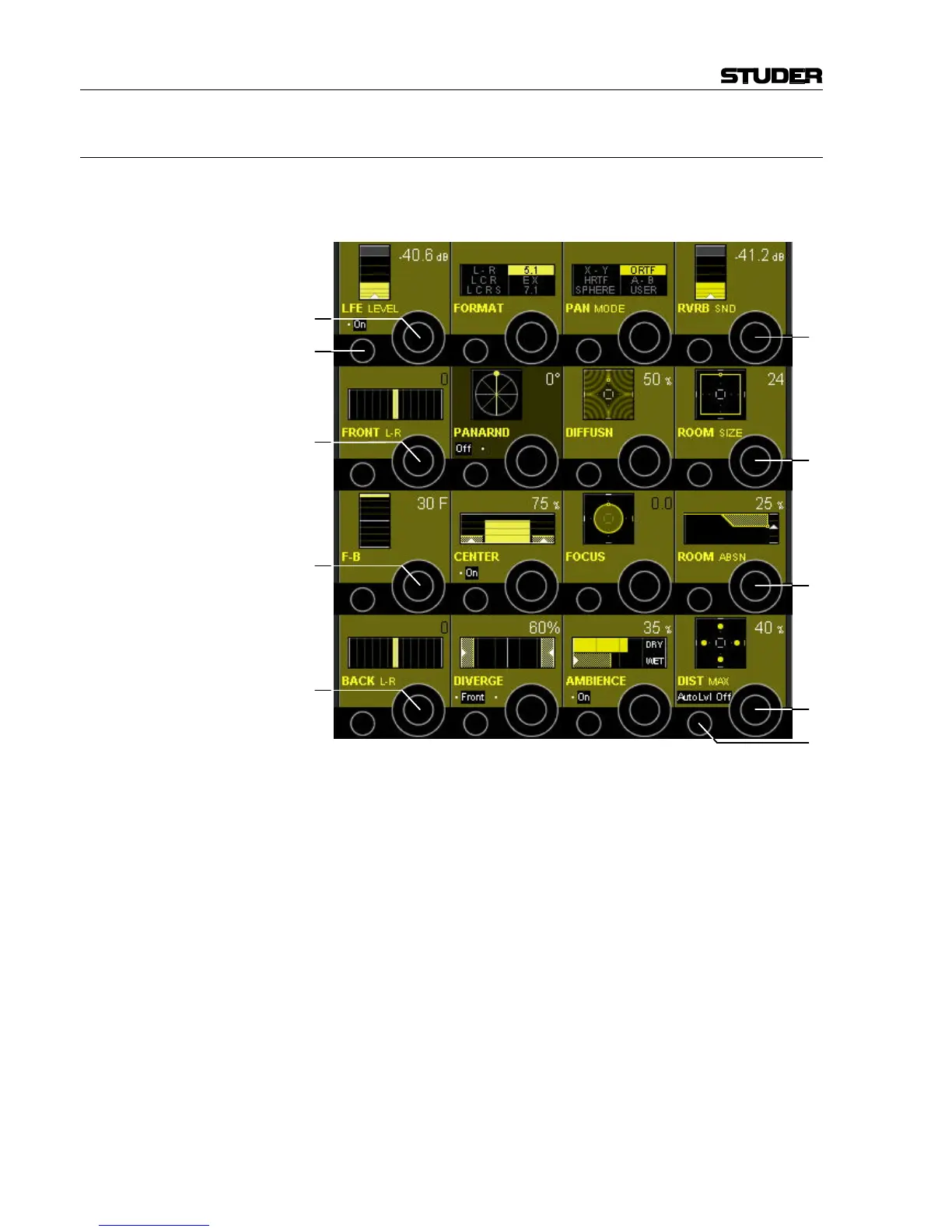
Please note that items [75] through [86] (i.e., the left part of the graphic
below) are identical with the ones in chapter 3.4.3.2 – for details, please
refer to the description in that chapter.
PAN MODE [87] Sets the overall panning algorithm used to position the mono source in the
desired direction. In all but the X-Y mode, a stereo microphone simulation
is employed which will yield a more diverse sound field. For more details
on PAN MODEs please refer to chapter 3.6.
• X-Y – A standard panning algorithm that only changes the amplitude of
the signal to the various buses in relation to the position of the panner.
This operation is well known and is used in all conventional panners.
• A-B – An idealized version of the common setup using omni-directional
microphones. With this mode the sound stage is perceived as large, and
is useful for solo instruments, audience, and choir. The positioning of
the source is only established by changes in time delays.
• ORTF – An idealized version of the common cardioid microphone
setup according to angles and distances used for stereo miking. A more
accurate sound field is created through the manipulation of both ampli-
tude and time differences.
• SPHERE – This mode emulates a spherical microphone as shown in
chapter 3.6.7. The spherical microphone has two capsules mounted into
a sphere having a diameter of about 18 cm. The sphere incorporates dif-
ferent effects on the two channels, including amplitude, delay and shad-
owing of the high frequencies on the channel which is not facing the
[81]
[78]
[80]
[79]
[93]
[96]
[90]
[91]
[75]
[84]
[77]
[86]
[88]
[82]
[87]
[94]
[95]
[89]
[83]
[76]
[85]
[92]



 To Next Page