Vista Digital Mixing System
8-36 Vista 8 Differences
SW V3.5 Date printed: 05.04.2005
8.6.8 Matrix Buses
This type of bus/output is used very often for live applications, particularly
in PA operation. A matrix bus is a kind of an auxiliary bus typically fed
only by master channels (subgroups, masters, aux masters), but not from
input channels. The Configuration Editor 3.4 application (and newer) of-
fers the possibility to talk from master channels to auxiliary buses. It is
therefore possible to have a “super auxiliary” bus that can be fed from any
channel within the console. However, very often this may be confusing.
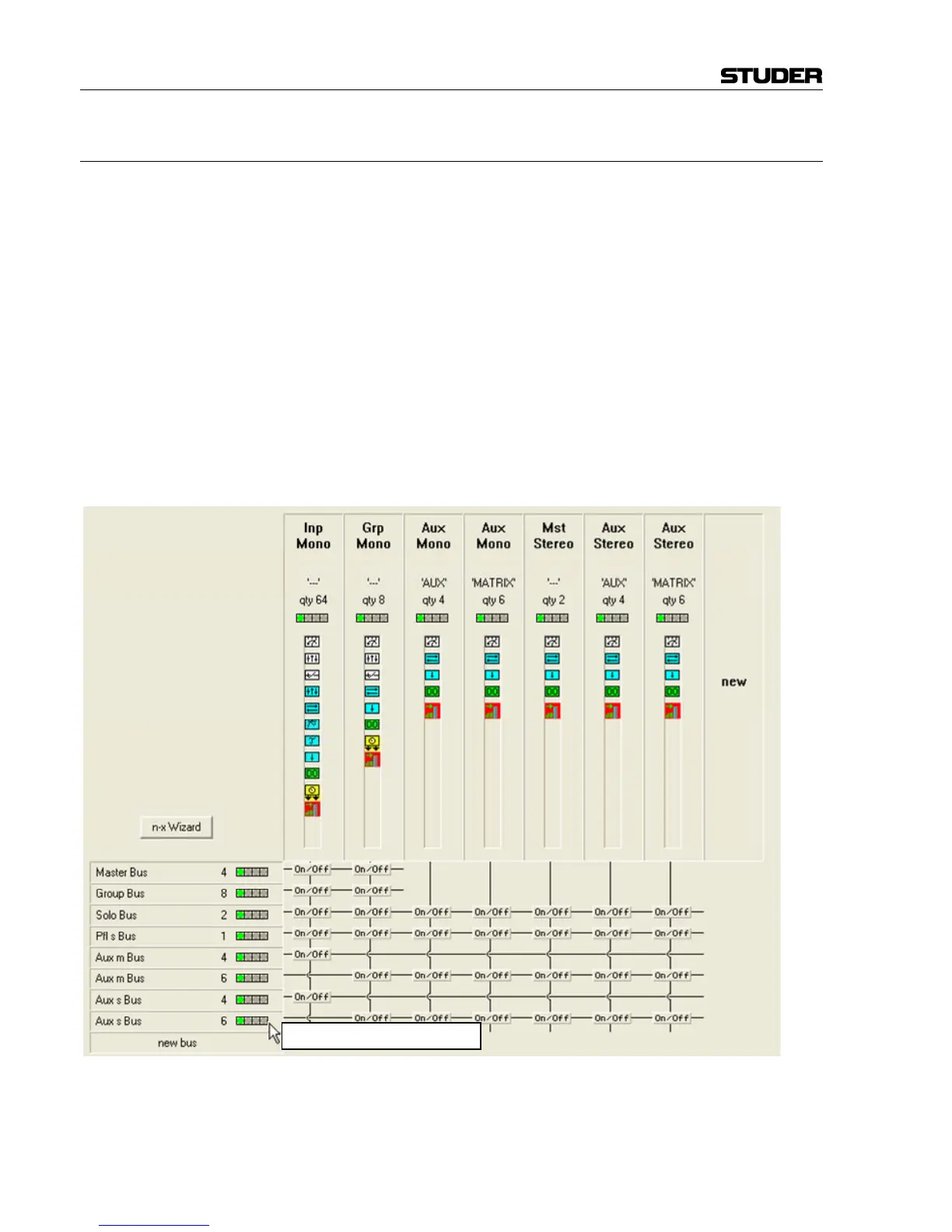
The Configuration Editor software easily allows the software to know
whether you intend to use a certain auxiliary bus as a typical aux bus (no
actions necessary) or whether you want to use it as a matrix bus with typi-
cal feed possibilities (right-click on the Aux Bus field in the
CHANNEL/BUS view, as shown below). The latter will remove the possi-
bility to talk to this bus from input channels, but instead will add feeds
from all master channels. This is identical to a matrix bus, and the corre-
sponding master channels can be used as matrix outputs. They may even be
equipped with signal processing, such as EQ, dynamics, or delay, in order
to satisfy the specific needs of each customer.
To avoid confusion about which master is a “true” auxiliary master and
which one is a matrix output, it is recommended to rename the user label of
the “matrix style” master channels to MATRIX 1, for example. This name
will then be propagated and properly displayed on the input channels – as
described at the beginning of these notes.
Standard AUX Bus
Matrix-Style AUX Bus
Standard AUX Bus
Matrix-Style AUX Bus
Right-Click to Define AUX Usage



 To Next Page