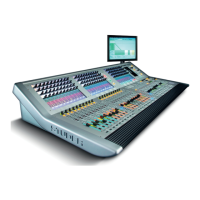
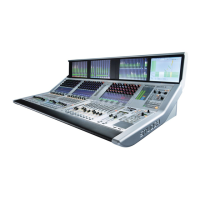
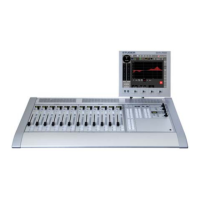
Vista Digital Mixing System
Date printed: 05.08.03 SW V3.3 Parameters 3-41
3.6 VSP Quick Operating Guide
With the release of the V2.5 software for the D950/Vista mixing consoles,
Studer has also created an enhanced version of its proprietary room mod-
eling software called VSP (= Virtual Surround Panning). VSP is unique in
that it can truly produce acoustic scenes that emulate real-world room
spaces within an audio console.
This latest enhancement to Studer’s VSP has several significant advan-
tages:
• Reverberation is generated so that complete room simulation can now be
achieved without the need for any external signal processing gear
• Diffusion filters permit finely-tuned room impulse response modeling
• Focus Control allows balancing of early reflections
• DSP code optimization uses less DSP resources than previous versions,
even with the added functionality.
This Chapter Although the functionality of the VSP software has been greatly enhanced,
every effort has been made to simplify its use by the mixing engineer. The
purpose of this chapter is to provide brief operating instructions so that the
VSP software may be used in an efficient and creative manner. Because of
the immensely creative possibilities available when using VSP, the mixing
engineer is urged to use this operating guide, as, well, just that... as a
guide. It is suggested that the VSP be explored through experimentation
once the control usage is understood, so that its full range of potential can
be achieved.
3.6.1 What is VSP?
Virtual Surround Panning is a parameterized audio positioning tool for
realistically imaging a mono source using a two- to eight-channel playback
system.
• Early reflections are generated within a simulated acoustic space, depend-
ing on the pan position set on the VSP panner. These reflections are repro-
duced from the correct direction, and at the correct time.
• Phase and frequency spectrum information can be added to the customary
amplitude difference between left and right loudspeakers.
• Late cluster reflections (reverberation) are generated to complete the room
simulation.
All of the above result in the following advantages over conventional pan-
ners:
• True acoustic imaging can be achieved that is impossible with standard
amplitude-based panners. Sound sources can be placed accurately both
between the speakers as well as beyond them.
• Distance can be perceived.
• 5.1 sound fields (or acoustic scenes) can be created that simulate true room
spaces.
• Multiple rooms can be built within the console.
• All of the settings are captured within both the console snapshots and the
dynamic automation system.
• All playback channels are used to support the realistic impression of
placement and position.



 To Next Page