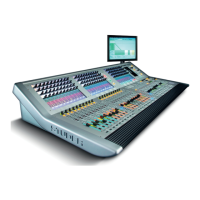
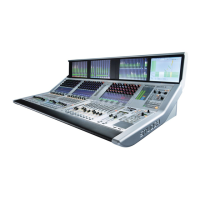
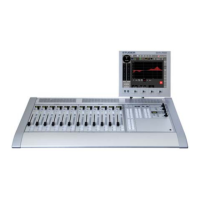
Vista Digital Mixing System
1-18 Introduction SW V3.3 Date printed: 05.08.03
1.4 Processing Blocks
Equalizers Four fully parametric bands are provided on the Vista. Each band, which
can be switched in and out independently, extends from 20 Hz to 20 kHz,
with a ±18 dB gain range. The EQ features a psycho-acoustically corrected
frequency response for high frequencies, similar to well-known analog EQ
designs. The two mid-bands can be switched between constant-Q and con-
stant-range modes. The high and low frequency bands can also be switched
to shelving mode. A second EQ type is available (defined in the Configu-
ration Tool), which features an additional Notch filter.
Filters Low-cut and high-cut filters are provided, with cutoff frequencies that are
variable between 20 Hz and 20 kHz, and slope selections of 12, 18, or
24 dB/octave.
In addition, an analog low-cut filter with a cutoff frequency of 75 Hz and a
slope of 12 dB/octave is available in the D19m Mic/Line preamplifier.
Dynamics The Vista dynamics processing consists of four parts:
Limiter, Compressor, Expander, and Gate.
To avoid pumping and modulation, the dynamics processing sections fea-
ture high sampling rate transient detection. Distortion artifacts are minim-
ized through selectable, program-dependent attack and release times. The
Vista’s dynamics feature a side-chain input that can be used with or with-
out HP/LP filters. A unique “look forward” function is also featured. If de-
sired, this allows the entire transient portion of a waveform to be affected
when using the limiter/compressor or to be passed when the expander/gate
is used.
Soft Clip In addition, a soft clip function can be activated in the D19m Mic/Line
preamplifier.
1.5 Monitoring and Communication
Monitoring The Control Room (CR) monitoring section provides control of up to three
different speaker systems (two multi-channel and one stereo) and 16 source
selectors. All internal digital sources can be assigned to any of the source
selector keys. A headphone socket is also supplied for use within the con-
trol room.
The Studio Monitor is configurable in the same way as the CR monitor
section, although only one stereo loudspeaker pair is supported.
Talkback An extensive talkback system is implemented within the Vista. The talk-
back source can be either the built-in desk-operator microphone or an ex-
ternal producer microphone. Several destinations, such as buses, direct
outputs, auxiliaries, groups, and master outputs are available block.
On Vista 6 only, each channel is fitted with a talkback key that activates
talkback to the direct output of the corresponding channel and, if the chan-
nel is an N–1 owner, to the N–1 output.
Refer to the talkback and signaling block diagram on the next page for
details.



 To Next Page