STUDER 21. Sep. 2004 Release Notes Vista 3.4
10/18
5. Press the mute group master again in order to select another one. Please note that it is
possible to build up hierarchies as well. In other words it is possible to contain individual
channels as well as another mute group master within a mute group. Hierarchies are not
indicated on the desk once the set-up menu is quit. Membership of a channel to one or
multiple mute groups are indicated in the area below the channel labels.
This channel is part of Mute Groups 1,3 and 8
6. Press "Ctrl Grp Setup" again in order to leave the setup mode.
Where are the mute groups stored?
The information, which channel belongs to which mute group is stored within a so called
“start snapshot” of each title. In other words this information is stored once per title, at the
moment when it is closed. However, the state of the mutes in each channel is stored within
each snapshot.
10. Exclude certain patch targets from being changed by snapshots
Some customers are using our consoles as audio routers for other studio installations and are
controlling our internal router by protocols such as Probel or ARMI. When recalling console
snapshots, the patch points set by those devices are reset to the value of the snapshot, even if this
was not always requested. With software release 3.4 it is possible to define certain patch targets as
"isolated from snapshot recalls". In other words: The user defines the patch outputs which are
controlled by Probel/ARMI devices and therefore makes those targets completely independent from
snapshot recalls by the console operator. This set-up is typically done once on a system. See service
information about how to set-up this isolation.
11. Possibility to import labels from 3
rd
party systems
We are making integration of our systems with 3
rd
party products even more seamless. We are now
offering the possibility to exchange label information with external router systems such as Probel
and Grass Valley. By using a serial connection, it is possible to set-up a permanent label exchange in
the way, that the "device labels" used in the Vista and D950 are permanently overwritten by
received labels from the 3
rd
party router. This means that you will automatically see the name of
the original sources on your channel strip, even if a large routing system is placed before your
console.
Studer supports two label exchange protocols: Pro-Bel SW-P-08 and Grass Valley Group Series 7000.
Normally this feature is only used for importing of labels from the external devices. However, when
using Pro-Bel SW-P-08 protocol, Studer supports also export of output interface labels. It is
therefore possible to connect two Vistas together and get the labels automatically from one Vista
transferred to the other one.
Note: If you plan to use this feature, please contact Studer Service & Support beforehand.
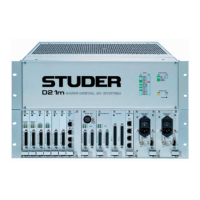
12. Full software support of new D21m IO system
The D21m IO system has now been completed by microphone input cards as well as the possibility to
connect remote IO boxes (stageboxes) over MADI to a "hub" frame next to the DSP core. For systems
already installed, there is nothing new with this software. However, for new systems delivered with
the D21m IO system we shall explain the additional functionality provided by the D21m IO system.
Automatic detection of IO setup
The D21m IO system is very much a "plug-and-play" unit. There is no longer any need to tell
the system which ports have microphone preamplifier cards connected, nor is it necessary
to define the presence of such cards at the time of configuration (in the Configuration
Editor Software). This also means that there is no sub-patch "External Devices" anymore in
the general patch window. The philosophy of automatic IO detection works as follows:



 To Next Page